

Valve Gate Systems for Premium Thin-Wall Containers
Valve gates are the dominant gate type for thin-wall food packaging molds, used on approximately 80 percent of new mold builds for HWAMDA SPV5 production lines. The valve pin (H13 steel, nitrided to 60-65 HRC, typically 2.0-3.0mm diameter for PP thin-wall) mechanically closes the gate orifice at the end of the holding phase, producing a flat, vestige-free gate mark of 2.0-3.5mm diameter. This clean appearance is essential for printed food containers where the gate area may be visible to consumers. YUDO SUMR and Synventive SVG+ systems are the most commonly specified valve gate brands for HWAMDA SPV5 molds. Gate orifice diameter for PP thin-wall is typically 1.2-2.0mm: yogurt cups (0.5mm wall) use 1.4-1.8mm orifice, sauce cups (0.35-0.5mm wall) use 1.2-1.5mm orifice, and food containers (0.5-0.7mm wall) use 1.6-2.0mm orifice. The gate land length should be 0.5-1.0mm to minimize pressure drop while maintaining clean shut-off. Pneumatic valve actuators operating at 5-6 bar provide response times of 30-50 milliseconds, while hydraulic actuators at 80-120 bar achieve 20-30 millisecond response for the fastest cycle applications.
Key Specs
- •The valve pin (H13 steel, nitrided to 60-65 HRC, typically 2.0-3.0mm diameter for PP thin-wall) mechanically closes the gate orifice at the end of the holding phase, producing a flat, vestige-free gate mark of 2.0-3.5mm diameter.
- •Gate orifice diameter for PP thin-wall is typically 1.2-2.0mm: yogurt cups (0.5mm wall) use 1.4-1.8mm orifice, sauce cups (0.35-0.5mm wall) use 1.2-1.5mm orifice, and food containers (0.5-0.7mm wall) use 1.6-2.0mm orifice.
- •The gate land length should be 0.5-1.0mm to minimize pressure drop while maintaining clean shut-off.

High-speed injection unit with linear guides
Gate Location Strategies for Food Packaging Products
Gate location determines fill pattern, weld line position, and warpage tendency. For round containers (yogurt cups, sauce cups) running on HWAMDA SPV5 machines, center-bottom gating provides the most symmetrical fill pattern with radial flow expanding uniformly from the gate toward the rim. This produces minimal warpage because the flow orientation is symmetrical in all directions. The gate is positioned at the center of the container base, requiring the core to incorporate the valve gate nozzle and the ejector system to work around the gate location. For rectangular food containers, center gating may not be optimal if the aspect ratio exceeds 2:1 -- the flow must travel further to the short corners, risking hesitation marks. Multiple gates (2 or 4 gates per cavity) distribute flow for rectangular containers above 120mm in length. Gate spacing should be calculated so that the flow fronts from adjacent gates meet at the midpoint with melt temperature still above 200 degrees C. For IML containers where label placement requires a specific orientation, gate location must avoid direct impingement on the label area to prevent label displacement during filling. On HWAMDA SPV5 IML lines, the gate is positioned at the container bottom center with a deflector rib directing flow parallel to the label surface.
Gate Sizing Calculations for Thin-Wall PP Applications
Gate diameter sizing follows the principle of matching the gate cross-sectional area to the part wall thickness and required flow rate. For thin-wall PP containers, the gate diameter (D) in mm can be estimated by: D = (4 x Q / (pi x V))^0.5, where Q is the volumetric flow rate (cm3/s) and V is the desired gate velocity (m/s). At gate velocities of 200-400 m/s typical for thin-wall PP, shear rates through a 1.5mm gate reach 80,000-150,000 s-1. Excessive shear rate above 200,000 s-1 causes molecular degradation and gate blush. For an 8-cavity yogurt cup mold on the HWAMDA HMD 380M8-SPV with 368 mm/s screw speed and 55mm screw diameter, the total volumetric flow rate is approximately 875 cm3/s, divided among 8 cavities = 109 cm3/s per gate. At a target gate velocity of 300 m/s, the required gate diameter is 1.5mm. Gate depth (for edge gates) or land length (for valve gates) affects the gate freeze time, which determines the effective holding time. A 1.5mm diameter valve gate on 0.5mm-wall PP freezes in approximately 0.8-1.2s at 30 degrees C mold temperature, establishing the minimum holding time for full packing. Under-sized gates freeze prematurely, causing under-packed parts with sink marks and low weight.
Key Specs
- •At gate velocities of 200-400 m/s typical for thin-wall PP, shear rates through a 1.5mm gate reach 80,000-150,000 s-1.
- •For an 8-cavity yogurt cup mold on the HWAMDA HMD 380M8-SPV with 368 mm/s screw speed and 55mm screw diameter, the total volumetric flow rate is approximately 875 cm3/s, divided among 8 cavities = 109 cm3/s per gate.
- •At a target gate velocity of 300 m/s, the required gate diameter is 1.5mm.
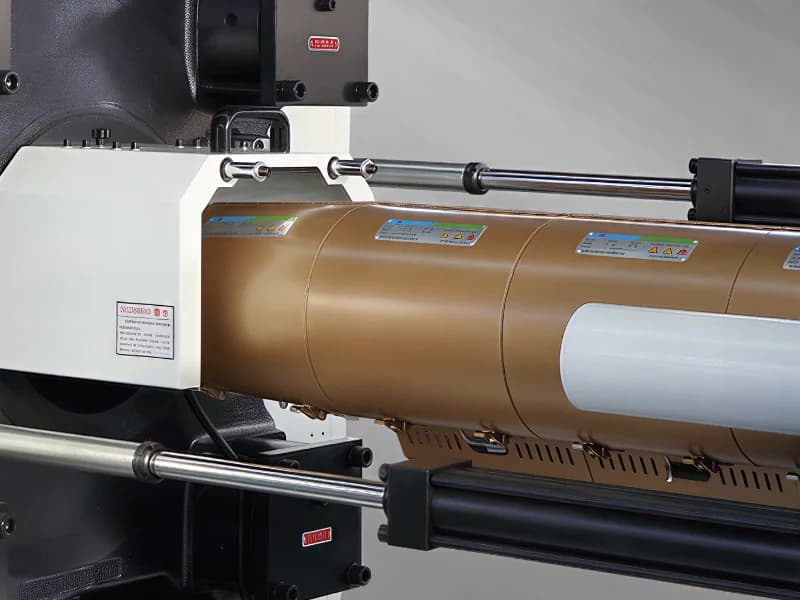
Servo-hydraulic drive system with energy recovery
Need Expert Advice?
Talk to our engineers about your specific production requirements. Free consultation.
Edge Gate and Fan Gate Applications
While valve gates dominate food packaging, edge gates and fan gates remain relevant for specific thin-wall applications, particularly lids, trays, and rectangular containers where side gating produces better flow patterns than center gating. An edge gate for a thin-wall container lid running on HWAMDA SPV5 machines has typical dimensions of 0.6-0.8mm depth x 3-5mm width x 0.8-1.2mm land length. The width-to-depth ratio of 5:1 to 8:1 distributes the melt across a broader front, reducing the jetting tendency seen with narrow gate geometries at high injection speeds. Fan gates extend this principle further, with widths of 8-15mm tapering gradually from the runner to the cavity. Fan gates are particularly effective for flat, wide parts like container lids where uniform flow across the full width prevents warpage from asymmetric molecular orientation. The disadvantage of edge and fan gates is the post-molding gate vestige that requires trimming -- either by manual degating or an automated trimming station downstream. For high-volume production on HWAMDA SPV5 lines, the labor cost of degating typically makes valve gates more economical despite the higher mold cost, unless production volumes are below 2 million parts per year.
Venting Design Adjacent to Gate Areas
Proper venting at and around the gate area prevents burn marks, short shots, and surface defects on thin-wall parts. At the gate itself, the transition from the runner to the cavity must allow trapped air to escape ahead of the melt front. For PP thin-wall molding on HWAMDA SPV5 machines, vent depth at the parting line is 0.02-0.03mm (PP will flash at depths above 0.04mm at the 130-180 MPa cavity pressures typical of thin-wall filling). Vent width should be 5-8mm, with a 3-5mm land length before opening to a 0.5-1.0mm relief channel that exits to atmosphere. The total vent area on a thin-wall mold should provide 15-25 percent of the projected parting line perimeter. For round containers gated at center bottom, venting at the rim is critical -- this is where the flow front terminates and the last air must escape. Ring vents machined into the core or cavity insert at the top rim provide 360-degree venting with total vent cross-section of 2-4 mm2. Vacuum-assisted venting, where a vacuum pump evacuates the cavity to -0.7 to -0.9 bar before injection, reduces the required vent area and enables faster filling speeds. On HWAMDA SPV5 machines, the INOVA controller can trigger the vacuum valve at mold close, providing 0.3-0.5s evacuation time before injection begins.
Key Specs
- •For PP thin-wall molding on HWAMDA SPV5 machines, vent depth at the parting line is 0.02-0.03mm (PP will flash at depths above 0.04mm at the 130-180 MPa cavity pressures typical of thin-wall filling).
- •Vent width should be 5-8mm, with a 3-5mm land length before opening to a 0.5-1.0mm relief channel that exits to atmosphere.
- •Ring vents machined into the core or cavity insert at the top rim provide 360-degree venting with total vent cross-section of 2-4 mm2.
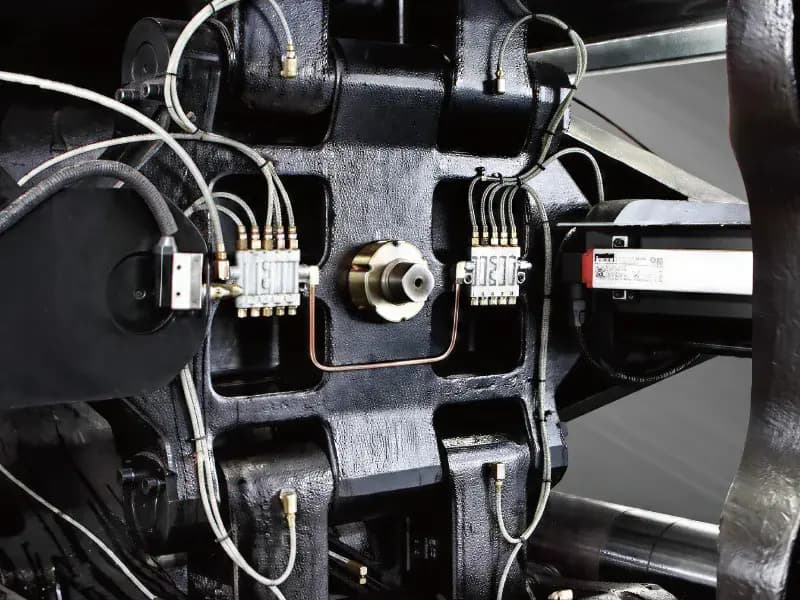
Toggle clamping unit — high rigidity for thin-wall molding
Gate Troubleshooting for Common Thin-Wall Defects
Gate-related defects in thin-wall molding are identifiable by their location and pattern. Gate blush (whitening or haze surrounding the gate mark) occurs when the melt experiences excessive shear or temperature change at the gate entrance. On HWAMDA SPV5 machines, the primary corrective action is adjusting the first-stage injection speed: increase from 150 to 250 mm/s for a slower initial gate entry, then ramp to full speed after the melt establishes a stable flow front 5-10mm past the gate. Jetting (a snake-like pattern originating from the gate) indicates the melt jet is not contacting the opposite cavity wall to form a proper flow front. Corrective actions include enlarging the gate orifice by 0.2-0.3mm, reducing first-stage speed, or adding a deflector geometry opposite the gate. Stringing (threads of material between the gate and the part after mold opening) on valve gate molds indicates the valve pin is not seating fully -- check pin wear, actuator pressure (pneumatic: 5-6 bar, hydraulic: 80-120 bar), and seat geometry. Gate vestige height variation across cavities indicates differential valve pin wear -- measure vestige height with a depth micrometer and replace the most worn pins. Target vestige height for food packaging is 0.1mm or less above the container surface.
Frequently Asked Questions
For 0.5mm wall PP yogurt cups on HWAMDA SPV5 machines, use a valve gate with 1.4-1.8mm orifice diameter and 0.5-1.0mm land length. This provides adequate flow for filling at 368 mm/s without excessive shear (keeping below 150,000 s-1). Center-bottom gating provides the most symmetrical fill pattern. The gate freezes in approximately 0.8-1.2s, defining the minimum holding time for proper packing.
Related Guides
Ready to Start Your Project?
Get a free consultation and quotation for your thin-wall packaging production line.
Join 500+ manufacturers in 60+ countries who trust HWAMDA.
Get Free Quote