

How Charging-on-Fly Works in the Molding Cycle
In a conventional injection molding cycle, the screw rotation phase that melts and meters the next shot of PP resin occurs after the mold opens and parts are ejected, adding 1.5-3.0 seconds to the total cycle. Charging-on-fly overlaps this plasticizing phase with mold movements. On an HWAMDA SPV5 machine, the sequence works as follows: after injection and hold pressure are complete, cooling begins. As soon as the gate freezes, typically 0.3-0.8 seconds into the cooling phase, the screw begins rotating to plasticize the next shot while the part continues cooling. Simultaneously, the mold opens at speeds up to 1,200 mm/s, the SWITEK robot removes parts in 0.5-0.8 seconds, and the mold closes. By the time the mold is clamped and ready for the next injection, the screw has already metered the full shot volume of 475-929 cm3 depending on the model. The dual-pump servo-hydraulic system provides independent hydraulic circuits for clamping and injection functions, enabling true simultaneous operation without pressure interference between the two systems.
Key Specs
- •Simultaneously, the mold opens at speeds up to 1,200 mm/s, the SWITEK robot removes parts in 0.5-0.8 seconds, and the mold closes.
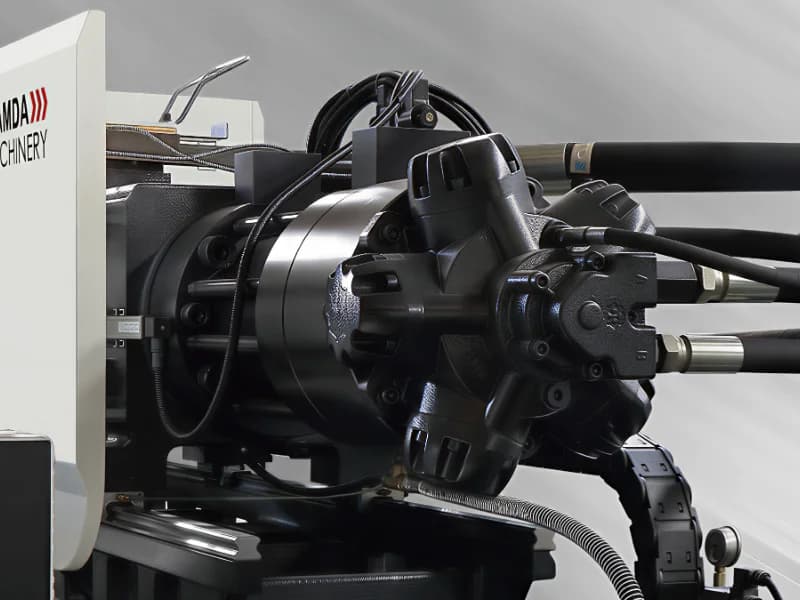
High-speed injection unit with linear guides
Cycle Time Savings: Before and After Comparison
The impact of charging-on-fly on cycle time is substantial and measurable. Consider an 8-cavity yogurt cup production on an HMD 400M8-SPV. Without charging-on-fly: injection takes 0.3 seconds at 442 mm/s, hold pressure runs 0.8 seconds, cooling lasts 1.5 seconds, mold open takes 0.6 seconds, ejection/robot takes 0.8 seconds, mold close takes 0.6 seconds, and plasticizing takes 1.8 seconds, totaling 6.4 seconds. With charging-on-fly: the same injection, hold, and cooling phases occur, but plasticizing happens simultaneously during mold open, ejection, and mold close. The screw rotates at up to 350 rpm during the 2.0-second mold movement window, completing the full 325 mm screw stroke needed for the next shot. Total cycle drops to 4.6 seconds, a savings of 1.8 seconds or 28%. Over a 24-hour production day, this difference equals 3,130 additional cycles, producing 25,043 more yogurt cups. At a selling price of 0.03 USD per cup, that represents 751 USD additional daily revenue from one machine.
Servo-Hydraulic System Requirements for Parallel Movement
Charging-on-fly requires a hydraulic system capable of delivering simultaneous flow to multiple actuators without pressure drops that would compromise either function. The HWAMDA SPV5 series achieves this through its dual-pump configuration: the HMD 270M8-SPV and HMD 308M8-SPV use 37+37 kW pump motors, mid-range models use 45+45 kW or 55+55 kW, and the largest HMD 530M8-SPV and HMD 600M8-SPV deploy triple-pump 55+55+37 kW and 55+55+55 kW configurations. Each pump operates independently on a dedicated servo motor, allowing one pump to power screw rotation at the required torque for plasticizing PP at 220-240 degrees Celsius while the other pump drives the toggle clamp mechanism. System pressure is maintained at 17.5-19 MPa across all operations. The servo control ensures that back pressure during plasticizing remains stable at 5-15 MPa regardless of clamp movement, preventing air inclusion and shot weight variation. This architecture is fundamentally different from single-pump machines where a flow divider must split oil between functions, resulting in reduced performance for both.
Key Specs
- •System pressure is maintained at 17.5-19 MPa across all operations.
- •The servo control ensures that back pressure during plasticizing remains stable at 5-15 MPa regardless of clamp movement, preventing air inclusion and shot weight variation.
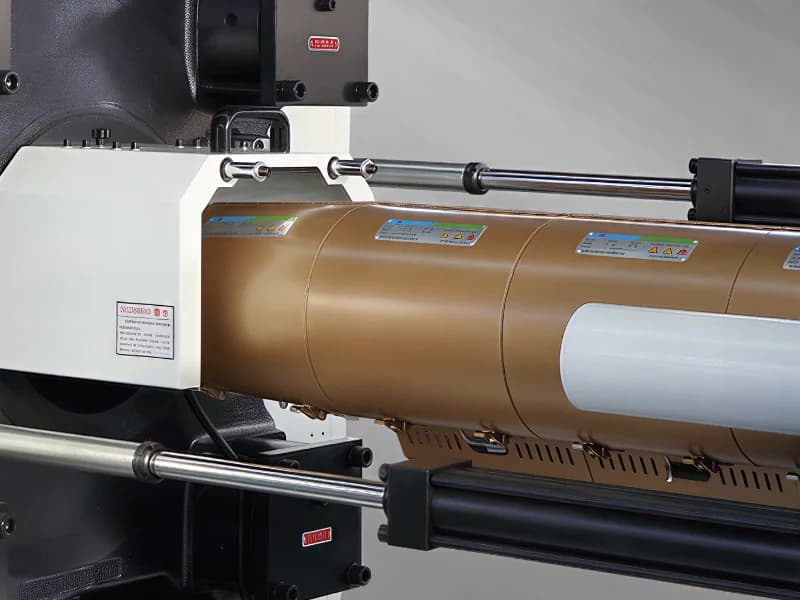
Servo-hydraulic drive system with energy recovery
Need Expert Advice?
Talk to our engineers about your specific production requirements. Free consultation.
Material Considerations for Charging-on-Fly
Not all materials respond equally well to charging-on-fly. High-flow PP grades with MFI of 35-80 g/10min, the standard for thin-wall food packaging on SPV5 machines, are ideal because they plasticize quickly and tolerate the screw speeds of 200-390 rpm used during parallel operation. The 6 heating zones on SPV5 barrel assemblies maintain uniform melt temperature across the screw length, even when plasticizing occurs during the vibration of mold movement. For PP processing at 220-260 degrees Celsius, the screw design with L/D ratios of 23:1 to 25:1 provides sufficient residence time for complete melting within the compressed plasticizing window. Random copolymer PP, used for transparent yogurt cup lids, requires slightly lower screw speeds of 150-250 rpm during charging-on-fly to prevent shear heating above 270 degrees Celsius, which causes yellowing. PET for milk tea cups demands more careful control, with screw speeds limited to 100-200 rpm and back pressure precisely maintained at 8-12 MPa to prevent acetaldehyde generation. The INOVA controller allows separate parameter sets for charging-on-fly based on the material being processed.
INOVA Controller Setup for Charging-on-Fly Operation
Configuring charging-on-fly on the HWAMDA SPV5 INOVA controller involves setting the plasticizing start trigger, screw speed profile, and back pressure during parallel operation. On the controller 10-inch touchscreen, navigate to the Parallel Movement setup page. Set the plasticizing start point to trigger at the beginning of the mold open phase, typically 0.1-0.3 seconds after hold pressure ends. Configure a two-stage screw speed profile: stage 1 at 80% of maximum speed for the first 70% of the screw stroke to rapidly meter the bulk of the shot, then stage 2 at 40-60% speed for the final 30% to ensure precise shot size control within plus or minus 0.3 grams. Back pressure during charging-on-fly should be set 10-15% higher than static charging to compensate for hydraulic flow variations during simultaneous clamp movement. The controller displays real-time screw position and plasticizing completion status, alerting the operator if the screw has not reached the set shot size before mold close completes. This prevents short shots that would occur if injection began with an incomplete charge. The INOVA system stores up to 500 mold-specific parameter sets including all charging-on-fly configurations.
Key Specs
- •Configure a two-stage screw speed profile: stage 1 at 80% of maximum speed for the first 70% of the screw stroke to rapidly meter the bulk of the shot, then stage 2 at 40-60% speed for the final 30% to ensure precise shot size control within plus or minus 0.3 grams.
- •Back pressure during charging-on-fly should be set 10-15% higher than static charging to compensate for hydraulic flow variations during simultaneous clamp movement.
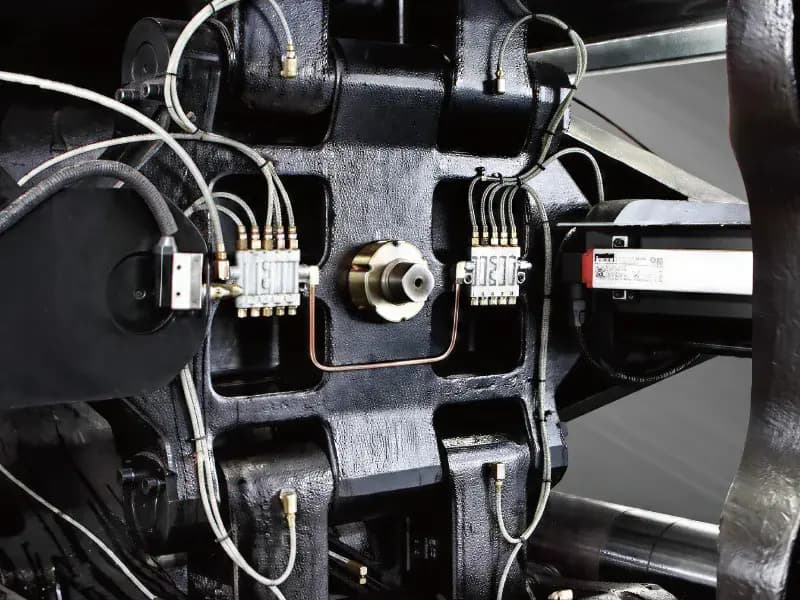
Toggle clamping unit — high rigidity for thin-wall molding
Troubleshooting Common Charging-on-Fly Issues
Several issues can arise when running charging-on-fly on thin-wall production lines. Incomplete plasticizing occurs when the screw cannot melt the full shot within the mold movement window, typically caused by insufficient screw speed or barrel temperature. Solution: increase screw speed by 10-20% or raise rear barrel zone temperature by 5-10 degrees Celsius. Shot weight variation exceeding plus or minus 0.5% indicates unstable back pressure during parallel operation. Check for hydraulic cross-flow between circuits by monitoring pressure gauges on both pumps simultaneously. Air bubbles in the melt, visible as silver streaks on molded parts, result from back pressure dropping below 3 MPa during charging-on-fly. Increase back pressure setpoint by 2-3 MPa and verify screw non-return valve is sealing properly. Excessive screw wear, indicated by increasing shot weight variation over time, can accelerate when charging-on-fly runs at maximum screw speed continuously. Use the stepped speed profile described above to reduce wear on screw flights and barrel liner. On SPV5 machines, the INOVA controller trend graphs help identify these issues by overlaying screw position, back pressure, and shot weight data cycle by cycle.
Frequently Asked Questions
Charging-on-fly typically saves 1.0-2.0 seconds per cycle on HWAMDA SPV5 machines, depending on shot size and screw diameter. For a 50 mm screw with 270 mm stroke processing PP, plasticizing takes approximately 1.8 seconds sequentially. With charging-on-fly, this overlaps with the 2.0-second mold movement window, saving the full 1.8 seconds. For larger 65 mm screws with 280 mm stroke, savings range from 1.5-2.5 seconds. This represents a 20-30% reduction in total cycle time.
Related Guides
Ready to Start Your Project?
Get a free consultation and quotation for your thin-wall packaging production line.
Join 500+ manufacturers in 60+ countries who trust HWAMDA.
Get Free Quote