

Mold Steel Grades and Expected Cycle Life
Mold steel selection is the single largest determinant of mold life in thin-wall applications. For high-volume production on HWAMDA SPV5 machines running at injection pressures of 158-182 MPa, three steel grades dominate. Premium molds use 1.2344 (AISI H13) hot work steel hardened to 48-52 HRC, delivering 5-10 million cycles for cavity inserts and withstanding the thermal cycling between 15-25 degrees Celsius cooling water and 220-260 degrees Celsius melt temperature. Mid-range molds use 1.2738 (P20+Ni) pre-hardened steel at 30-36 HRC, suitable for 2-5 million cycles and commonly chosen for food container molds running at moderate cycle times of 5-8 seconds. Economy molds using 1.2311 (P20) steel at 28-32 HRC deliver 1-3 million cycles and are appropriate for trial molds or low-volume specialty products. Core pins and thin core inserts, which endure the highest stress in thin-wall molds with 0.35-0.70 mm wall sections, should always be made from H13 or premium grades like Bohler M340 regardless of the overall mold steel choice.
Key Specs
- •For high-volume production on HWAMDA SPV5 machines running at injection pressures of 158-182 MPa, three steel grades dominate.
- •Premium molds use 1.2344 (AISI H13) hot work steel hardened to 48-52 HRC, delivering 5-10 million cycles for cavity inserts and withstanding the thermal cycling between 15-25 degrees Celsius cooling water and 220-260 degrees Celsius melt temperature.
- •Mid-range molds use 1.2738 (P20+Ni) pre-hardened steel at 30-36 HRC, suitable for 2-5 million cycles and commonly chosen for food container molds running at moderate cycle times of 5-8 seconds.
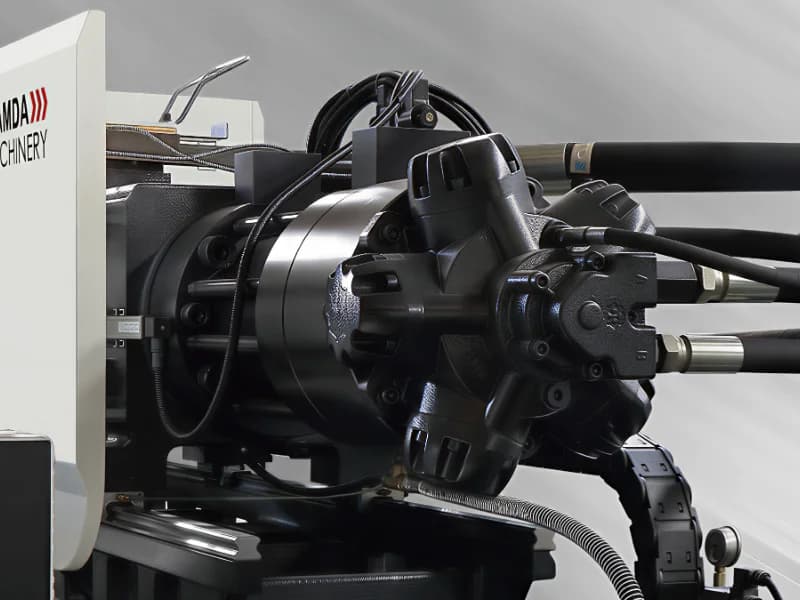
High-speed injection unit with linear guides
How Cavity Count Affects Mold Longevity
Higher cavity counts increase the total stress on a mold during each cycle due to greater projected area and higher required clamping force. An 8-cavity yogurt cup mold with 0.40 mm wall thickness requires approximately 350-400 tonnes of clamping force on an HMD 400M8-SPV, while a 4-cavity version of the same cup needs only 175-220 tonnes on an HMD 270M8-SPV. The higher clamping force accelerates wear on parting line surfaces, guide pins, and alignment components. Additionally, multi-cavity molds experience differential thermal expansion across the mold face, with outer cavities cooling faster than center cavities. This thermal gradient creates micro-fatigue in the steel, particularly around gate areas where injection pressure reaches 150-180 MPa. A well-designed 4-cavity mold typically outlasts an equivalent 8-cavity mold by 20-30% in total cycle life. However, the 8-cavity mold produces twice the output, so the cost-per-part for tooling is still lower despite shorter absolute mold life. For 16-24 cavity sauce cup molds, expect mold life at the lower end of the range, around 3-5 million cycles.
Critical Wear Points in Thin-Wall Molds
Thin-wall molds experience accelerated wear at specific locations that determine overall mold life. Gate areas endure the highest stress, with melt velocities exceeding 200 m/s through valve gates of 1.2-2.5 mm diameter. YUDO or Synventive valve gate nozzles used with SPV5 machines help control gate wear through hardened gate inserts rated for 5-8 million cycles. Parting line surfaces wear from repeated clamping at forces of 2,700-6,000 kN, with typical parting line step development of 0.01-0.02 mm per million cycles. Once parting line flash exceeds 0.05 mm, mold refurbishment is required. Core pins for thin sections of 0.35-0.50 mm are the most failure-prone components, susceptible to bending, cracking, and erosion. Cooling channel surfaces develop scale deposits that reduce cooling efficiency by 10-20% over 2-3 million cycles, increasing cycle time and part warpage. Ejector pins in thin-wall molds require precise alignment within 0.01 mm to prevent marking on parts as thin as 0.35 mm, and typically need replacement every 1-2 million cycles.
Key Specs
- •Gate areas endure the highest stress, with melt velocities exceeding 200 m/s through valve gates of 1.2-2.5 mm diameter.
- •Parting line surfaces wear from repeated clamping at forces of 2,700-6,000 kN, with typical parting line step development of 0.01-0.02 mm per million cycles.
- •Once parting line flash exceeds 0.05 mm, mold refurbishment is required.
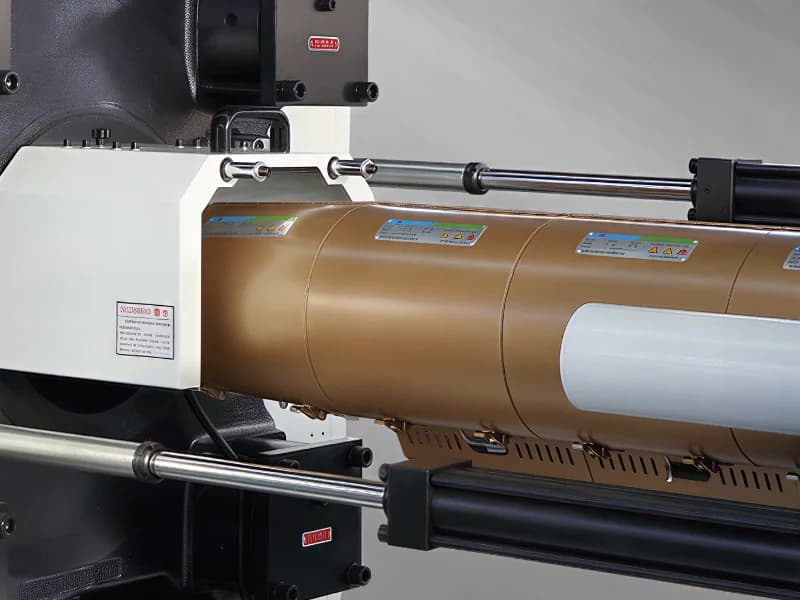
Servo-hydraulic drive system with energy recovery
Need Expert Advice?
Talk to our engineers about your specific production requirements. Free consultation.
Preventive Maintenance Schedule for Maximum Mold Life
A structured preventive maintenance program can extend thin-wall mold life by 30-50%. Daily checks during production on HWAMDA SPV5 machines should include visual inspection of parts for flash development, monitoring of cycle time drift beyond plus or minus 0.2 seconds, and verification of cooling water flow rates at 8-12 liters per minute per circuit. Every 250,000 cycles, perform a scheduled maintenance including ejector pin inspection and lubrication, guide pin wear measurement with limits of 0.02 mm, cooling channel flushing with descaling solution, and gate insert inspection under magnification. Every 1 million cycles, conduct a major overhaul including cavity surface polishing to restore SPI A-2 or better finish, parting line resurfacing if step exceeds 0.03 mm, replacement of all O-rings and seals, and hot runner system service including heater resistance testing and valve pin replacement. Every 3 million cycles, evaluate whether core pin replacement, cavity insert replacement, or complete mold refurbishment is the most cost-effective option. Document all maintenance in a mold log that tracks total cycles on the INOVA controller.
Calculating Your Mold Cost Per Part
Understanding mold cost per part helps justify investment in premium tooling. Consider a typical 8-cavity yogurt cup mold costing 80,000-120,000 USD. Running on an HMD 400M8-SPV at 4.5-second cycle time, 24/7 operation produces approximately 7.1 million cycles per year, generating 56.8 million cups. With an H13 steel mold lasting 8 million cycles, the mold amortizes over approximately 13.5 months, yielding a mold cost of 0.0015-0.0021 USD per cup. Compare this with a budget P20 mold at 45,000-60,000 USD lasting 2.5 million cycles: the mold cost per cup is 0.0023-0.0031 USD, plus you need 2.8 mold sets to cover the same production period. The premium mold delivers 25-30% lower total tooling cost while reducing production interruptions for mold changes. For sauce cup molds with 16-24 cavities, the math is even more favorable for premium steel, as the higher cavity count means each cycle produces more parts over which to amortize the tooling investment. Always factor in 15-20% additional cost for spare core pins and gate inserts in your initial tooling budget.
Key Specs
- •The premium mold delivers 25-30% lower total tooling cost while reducing production interruptions for mold changes.
- •For sauce cup molds with 16-24 cavities, the math is even more favorable for premium steel, as the higher cavity count means each cycle produces more parts over which to amortize the tooling investment.
- •Always factor in 15-20% additional cost for spare core pins and gate inserts in your initial tooling budget.
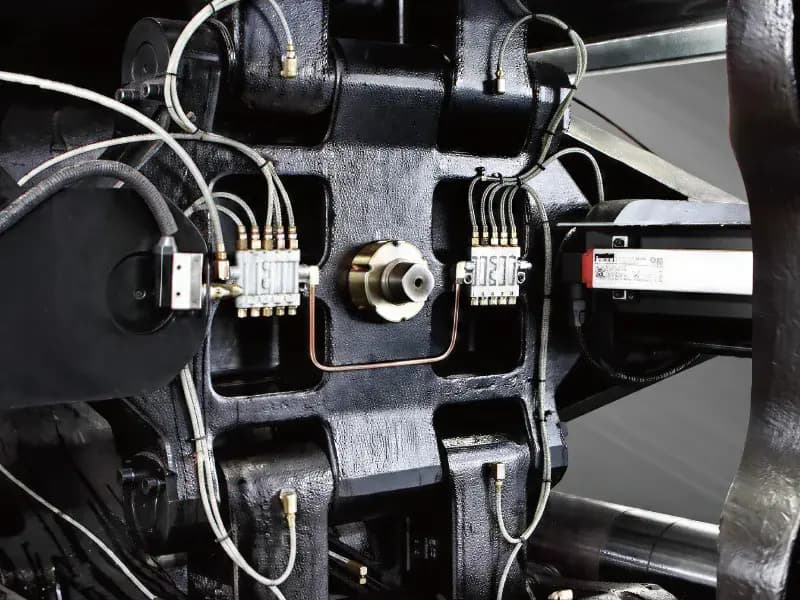
Toggle clamping unit — high rigidity for thin-wall molding
When to Replace vs Refurbish a Worn Mold
The decision to refurbish or replace a thin-wall mold depends on the extent and location of wear. Refurbishment is cost-effective when wear is limited to parting line surfaces that can be reground within 0.5 mm, gate inserts that can be individually replaced, ejector pins and springs that are standard replacement items, and cooling channels that can be cleaned or re-drilled. Refurbishment typically costs 15-25% of a new mold and extends life by 2-3 million cycles. Replace the mold when core-side steel shows fatigue cracking visible under dye penetrant inspection, cavity dimensions have drifted beyond tolerance with wall thickness variation exceeding plus or minus 0.05 mm, cooling channel corrosion has penetrated deeper than 1 mm into the steel, or the mold design is being updated for a new product version. On HWAMDA SPV5 machines, switching from a worn mold to a new or refurbished mold takes 2-4 hours using the hydraulic quick mold change system, with the INOVA controller storing and recalling all process parameters for the specific mold.
Frequently Asked Questions
Total part output depends on cavity count multiplied by cycle life. An 8-cavity yogurt cup mold in H13 steel lasting 8 million cycles produces 64 million cups. A 4-cavity food container mold in P20+Ni lasting 3.5 million cycles produces 14 million containers. A 16-cavity sauce cup mold in H13 lasting 5 million cycles produces 80 million cups. Running on HWAMDA SPV5 machines at 4-6 second cycle times, these volumes are achieved in 12-24 months of continuous operation.
Related Guides
Ready to Start Your Project?
Get a free consultation and quotation for your thin-wall packaging production line.
Join 500+ manufacturers in 60+ countries who trust HWAMDA.
Get Free Quote