

PP Homopolymer Structure and Key Properties for Thin-Wall Molding
Polypropylene homopolymer is a semi-crystalline thermoplastic with a melting point of 160-170C, density of 0.895-0.910 g/cm3, and crystallinity of 50-70% depending on processing conditions. For thin-wall injection molding, the critical property is melt flow index (MFI): standard grades at MFI 12-25 g/10min (230C/2.16kg, ISO 1133) suit general injection molding, while thin-wall grades require MFI 30-60+ g/10min for reliable filling of 0.35-0.5mm wall sections at L/t ratios exceeding 100:1. The high MFI is achieved through controlled reactor conditions producing lower average molecular weight with narrow molecular weight distribution (MWD). Tensile strength ranges from 30-40 MPa (ISO 527) for high-flow grades, with flexural modulus of 1,200-1,600 MPa (ISO 178) providing the stiffness required for rigid packaging. Heat deflection temperature (HDT) at 0.45 MPa reaches 90-110C, making PP suitable for hot-fill applications up to 85C. PP is FDA 21 CFR 177.1520 compliant and EU Regulation 10/2011 approved for food contact, recyclable under resin code 5.
Key Specs
- •Polypropylene homopolymer is a semi-crystalline thermoplastic with a melting point of 160-170C, density of 0.895-0.910 g/cm3, and crystallinity of 50-70% depending on processing conditions.
- •For thin-wall injection molding, the critical property is melt flow index (MFI): standard grades at MFI 12-25 g/10min (230C/2.16kg, ISO 1133) suit general injection molding, while thin-wall grades require MFI 30-60+ g/10min for reliable filling of 0.35-0.5mm wall sections at L/t ratios exceeding 100:1.
- •Tensile strength ranges from 30-40 MPa (ISO 527) for high-flow grades, with flexural modulus of 1,200-1,600 MPa (ISO 178) providing the stiffness required for rigid packaging.
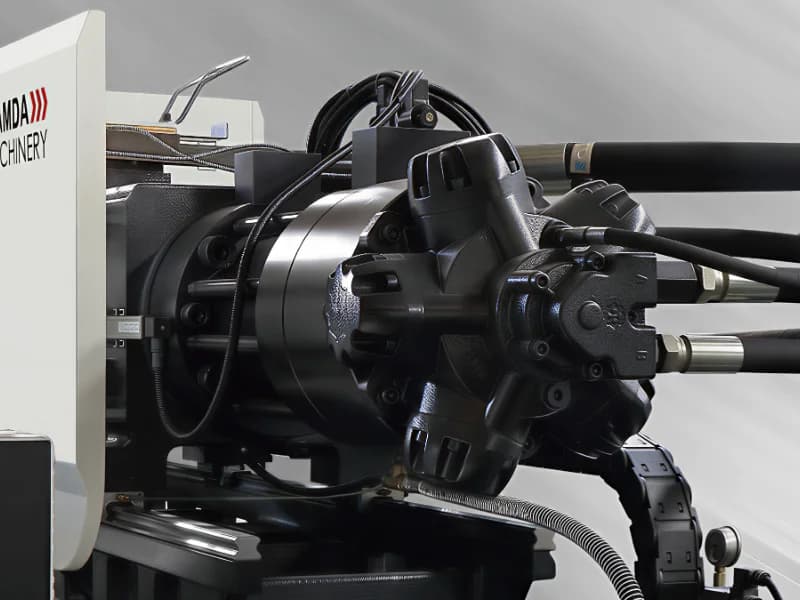
High-speed injection unit with linear guides
High-Flow PP Grades for Thin-Wall Applications
Selecting the correct PP homopolymer grade is critical for thin-wall production success. Tier 1 ultra-high-flow grades (MFI 50-60 g/10min) include LyondellBasell Moplen HP548R (MFI 50, designed specifically for thin-wall food packaging), Borealis BH348MO (MFI 45, nucleated for faster crystallization), SABIC PP 575P (MFI 47, excellent stiffness-flow balance), and ExxonMobil PP3155E5 (MFI 36, enhanced processability). Tier 2 standard thin-wall grades (MFI 30-45 g/10min) include Braskem CP442XP (MFI 42), IRPC P740J (MFI 44), Reliance H350FG (MFI 35, food-grade certified), and Borealis HJ325MO (MFI 25, random copolymer for clarity). Price ranges as of February 2026: EUR 1,510/MT in Europe, USD 1,027/MT in North America, USD 942/MT in China, and USD 930/MT in Northeast Asia. For HWAMDA SPV5 machines, grades with MFI 40+ g/10min are recommended for wall thicknesses below 0.45mm. Grades with MFI 30-40 may be used for 0.5-0.6mm walls. Nucleated grades (containing 0.1-0.3% sodium benzoate or organophosphate nucleating agents) reduce crystallization time by 20-30%, directly shortening cooling phase and overall cycle time.
Processing Parameters for SPV5 Machines
Optimal PP homopolymer processing on HWAMDA SPV5 machines follows specific parameter ranges validated across thousands of production installations. Barrel temperature profile: zone 1 (feed) 200-210C, zone 2 210-230C, zone 3 230-250C, zone 4 (nozzle) 240-260C. Higher-MFI grades (50+) process at the lower end; lower-MFI grades (30-40) require the upper range. Mold temperature: 20-40C for standard production (faster cycles) or 50-80C for enhanced surface gloss and crystallinity (slower cycles, better mechanical properties). Injection speed: 300-422mm/s depending on wall thickness and flow path length. For 0.4mm walls with 80mm flow path, 350-400mm/s is typical. Injection pressure: 150-220 MPa, with thin-wall applications requiring the upper range. Switchover point: position-based at 95-98% fill volume, with V/P switchover pressure typically 60-80% of peak injection pressure. Hold pressure: 40-60% of injection pressure for 0.3-0.8 seconds depending on gate freeze time. Back pressure: 10-15 MPa for adequate melt homogeneity. Screw recovery speed: 150-250 RPM for rapid plasticization within the cooling phase. Decompression (suck-back): 3-5mm to prevent drool from the Herzog nozzle.
Key Specs
- •Injection speed: 300-422mm/s depending on wall thickness and flow path length.
- •For 0.4mm walls with 80mm flow path, 350-400mm/s is typical.
- •Injection pressure: 150-220 MPa, with thin-wall applications requiring the upper range.
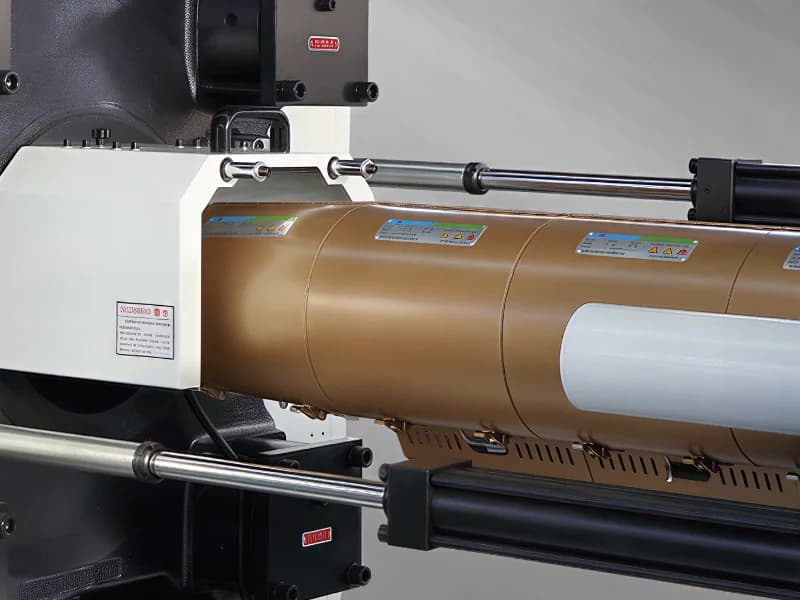
Servo-hydraulic drive system with energy recovery
Need Expert Advice?
Talk to our engineers about your specific production requirements. Free consultation.
Crystallization Behavior and Cooling Optimization
PP homopolymer's semi-crystalline nature makes cooling optimization critical for cycle time reduction while maintaining mechanical properties. Crystallization kinetics follow the Avrami equation: X(t) = 1 - exp(-K*t^n), where K is the crystallization rate constant (temperature-dependent) and n is the Avrami exponent (typically 2.5-3.0 for PP). Maximum crystallization rate occurs at approximately 100-110C for standard PP, but thin-wall parts cool rapidly through this range due to the high surface-to-volume ratio of 0.4-0.6mm wall sections. At mold temperatures of 25-35C (standard for thin-wall production), PP achieves approximately 40-50% crystallinity with fine spherulite structure, providing good balance of stiffness and impact resistance. Nucleated PP grades shift the crystallization onset temperature upward by 8-15C and increase overall crystallization rate by 20-30%, enabling 0.3-0.5 second reduction in cooling time. For a 6g yogurt cup at 0.4mm wall on an SPV5-400, cooling time is typically 1.5-2.0 seconds with nucleated PP versus 2.0-2.5 seconds with standard PP. Cooling circuit design with turbulent flow (Reynolds number >10,000) in mold cooling channels at 10-15C water temperature ensures efficient heat removal. The SPV5's process chiller maintains coolant temperature within +/-0.5C stability.
Common Defects and Troubleshooting with PP Homopolymer
Thin-wall PP homopolymer processing encounters specific defect modes requiring systematic troubleshooting. Short shots (incomplete fill): increase injection speed by 20-50mm/s increments, increase melt temperature by 5-10C, verify gate dimensions are minimum 0.8x wall thickness, and check for blocked cooling channels causing premature freeze-off. Flash (overfill): reduce injection speed at end of fill, verify clamp force exceeds projected area x cavity pressure (typically 3-5 tons/cm2 for thin-wall PP), and inspect mold parting line for wear or damage. Flow marks (surface streaks): increase melt temperature by 10-15C, increase injection speed for uniform flow front advancement, and ensure mold surface temperature is uniform within +/-3C across all cavities. Warpage (part distortion): common in PP due to differential crystallization between cavity and core sides; equalize cooling circuit temperatures, ensure uniform wall thickness within +/-0.05mm, and adjust hold pressure profile for uniform packing. Splay marks (silver streaks): indicates moisture content above 0.05%; increase drying time or temperature (80C for 2-4 hours in dehumidifying dryer with -40C dewpoint). Burn marks: reduce injection speed at end of fill, improve mold venting (vent depth 0.015-0.025mm for PP), and check for shear heating in narrow gates.
Key Specs
- •Short shots (incomplete fill): increase injection speed by 20-50mm/s increments, increase melt temperature by 5-10C, verify gate dimensions are minimum 0.8x wall thickness, and check for blocked cooling channels causing premature freeze-off.
- •Flash (overfill): reduce injection speed at end of fill, verify clamp force exceeds projected area x cavity pressure (typically 3-5 tons/cm2 for thin-wall PP), and inspect mold parting line for wear or damage.
- •Warpage (part distortion): common in PP due to differential crystallization between cavity and core sides; equalize cooling circuit temperatures, ensure uniform wall thickness within +/-0.05mm, and adjust hold pressure profile for uniform packing.
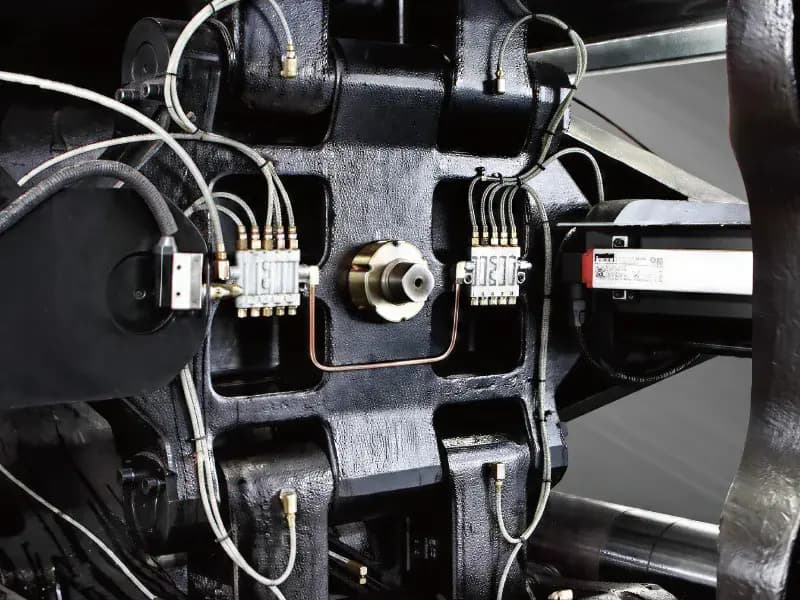
Toggle clamping unit — high rigidity for thin-wall molding
Sustainability and Recyclability of PP Homopolymer
PP homopolymer (resin identification code 5) is one of the most widely recyclable food packaging materials, supporting circular economy objectives increasingly demanded by brand owners and regulators. Mechanical recycling of post-consumer PP achieves 85-90% material recovery with 10-20% property reduction in tensile strength and impact resistance, acceptable for many non-food applications. For food-contact recycled PP (rPP), advanced recycling technologies (chemical recycling, dissolution/precipitation) can produce food-grade rPP meeting EU 2022/1616 and FDA no-objection requirements. Current rPP availability is limited, with food-grade rPP pricing at approximately USD 1,200-1,500/MT (20-40% premium over virgin). EU Packaging and Packaging Waste Regulation (PPWR) mandates minimum 10% recycled content in food-contact plastic packaging by 2030, increasing to 50% by 2040. Thin-wall design itself is a sustainability advantage: a 5g yogurt cup uses 40-50% less material than a 8-10g standard cup, reducing carbon footprint proportionally. HWAMDA SPV5 machines process PP/rPP blends (up to 30% recycled content currently validated) without machine modification, with minor adjustments to barrel temperature (+5-10C) and injection pressure (+5-10%) to compensate for increased melt viscosity of recycled materials.
Frequently Asked Questions
Use PP homopolymer with MFI 40-55 g/10min (230C/2.16kg) for 0.4mm wall thickness. Recommended grades: LyondellBasell Moplen HP548R (MFI 50), SABIC PP 575P (MFI 47), IRPC P740J (MFI 44), or Braskem CP442XP (MFI 42). Nucleated grades reduce cycle time by 0.3-0.5 seconds. Process at barrel temperatures of 230-255C with injection speed of 350-400mm/s on the HWAMDA SPV5 series.
Related Guides
Ready to Start Your Project?
Get a free consultation and quotation for your thin-wall packaging production line.
Join 500+ manufacturers in 60+ countries who trust HWAMDA.
Get Free Quote