

Melt Flow Index Requirements for Thin-Wall Applications
The melt flow index (MFI) of the PP grade is the primary selection criterion for thin-wall molding. Standard injection-grade PP with MFI of 10-15 g/10min (230 degrees C/2.16kg) cannot fill thin-wall cavities below 0.6mm wall thickness -- the melt freezes before reaching the cavity extremities. For yogurt cups (0.45-0.6mm wall), the minimum MFI is 25-30 g/10min. For sauce cups (0.35-0.5mm wall), MFI requirements increase to 40-60 g/10min. The highest flowability grades used for 0.3mm-wall containers reach MFI 80-100 g/10min, though mechanical properties deteriorate significantly at these levels. On HWAMDA SPV5 machines, the injection speed of 368-422 mm/s combined with injection pressures of 158-213 MPa can compensate for lower MFI grades to some extent -- a 35 MFI grade processed at 400 mm/s fills comparably to a 50 MFI grade at 300 mm/s, with the advantage of better part stiffness. The practical sweet spot for most food container applications is MFI 30-45 g/10min, providing reliable filling of 0.5mm walls in 8-cavity molds while maintaining top-load strength sufficient for stacking 6-8 units in retail display.
Key Specs
- •Standard injection-grade PP with MFI of 10-15 g/10min (230 degrees C/2.16kg) cannot fill thin-wall cavities below 0.6mm wall thickness -- the melt freezes before reaching the cavity extremities.
- •For yogurt cups (0.45-0.6mm wall), the minimum MFI is 25-30 g/10min.
- •For sauce cups (0.35-0.5mm wall), MFI requirements increase to 40-60 g/10min.
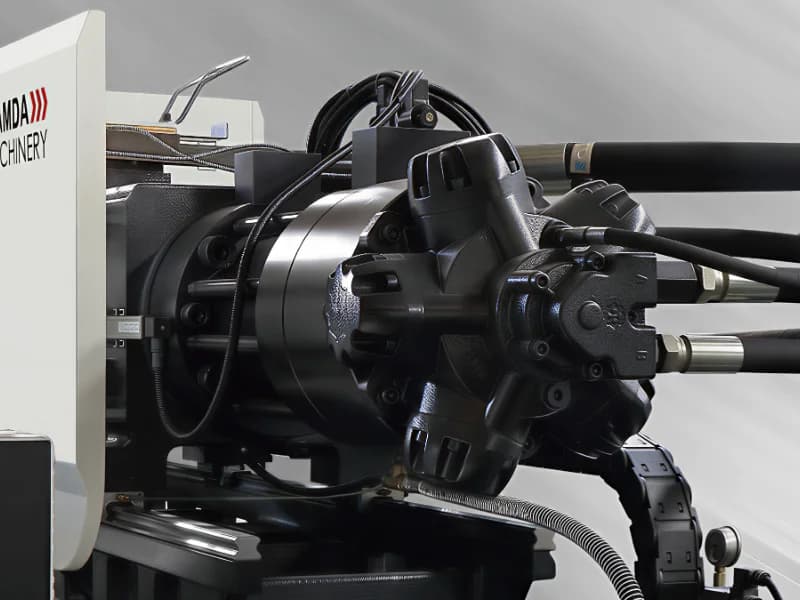
High-speed injection unit with linear guides
Specific PP Grades for Food Packaging Production
Leading resin suppliers offer PP grades specifically formulated for thin-wall food packaging. From SABIC: PP 575P (MFI 35, homo-PP, excellent stiffness for yogurt cups), PP 670K (MFI 55, clarified homo-PP for transparent containers). From LyondellBasell: Moplen HP548R (MFI 35, high-crystallinity homo-PP for food containers), Moplen HP561R (MFI 45, high-flow for thin-wall lids). From Borealis: BH348MO (MFI 45, heterophasic copolymer for cold-chain packaging with impact resistance at -20 degrees C). From CNPC/Sinopec: T30S (MFI 3, needs co-blending), PPH-Y35X (MFI 35, cost-effective for price-sensitive markets). Processing temperatures on HWAMDA SPV5 machines vary by grade: homo-PP grades at 220-245 degrees C, random copolymers at 210-235 degrees C, and high-MFI clarified grades at 230-255 degrees C. The mold temperature for food packaging is typically 20-35 degrees C for fast crystallization and short cycle times. Switching resin suppliers requires a qualification run of minimum 2,000 shots to confirm dimensional stability, weight consistency, and visual quality.
Homo-PP vs Random Copolymer vs Impact Copolymer
Three PP architectures serve different food packaging applications. Homo-PP (homopolymer polypropylene) provides the highest stiffness (flexural modulus 1,300-1,800 MPa) and fastest crystallization, making it the default choice for thin-wall yogurt cups and food containers where top-load strength is critical. A 6g homo-PP yogurt cup with 0.5mm wall achieves 25-35N top-load compression, sufficient for stacking. Random copolymer PP (RCP) incorporates 1-7 percent ethylene comonomer, reducing crystallinity to provide excellent optical clarity (haze below 15 percent on 1mm thickness) and lower heat seal initiation temperature (120-130 degrees C versus 145-155 degrees C for homo-PP). RCP is preferred for transparent food containers and for applications requiring peelable lid sealing. Impact copolymer PP (ICP) contains a rubber phase providing high impact strength at low temperatures (notched Izod above 5 kJ/m2 at -20 degrees C), essential for frozen food packaging and cold-chain distribution. The trade-off is slower crystallization requiring 0.5-1.0s longer cooling on HWAMDA SPV5 molds, plus higher shrinkage (1.8-2.5 percent versus 1.3-1.8 percent for homo-PP).
Key Specs
- •Homo-PP (homopolymer polypropylene) provides the highest stiffness (flexural modulus 1,300-1,800 MPa) and fastest crystallization, making it the default choice for thin-wall yogurt cups and food containers where top-load strength is critical.
- •A 6g homo-PP yogurt cup with 0.5mm wall achieves 25-35N top-load compression, sufficient for stacking.
- •Random copolymer PP (RCP) incorporates 1-7 percent ethylene comonomer, reducing crystallinity to provide excellent optical clarity (haze below 15 percent on 1mm thickness) and lower heat seal initiation temperature (120-130 degrees C versus 145-155 degrees C for homo-PP).
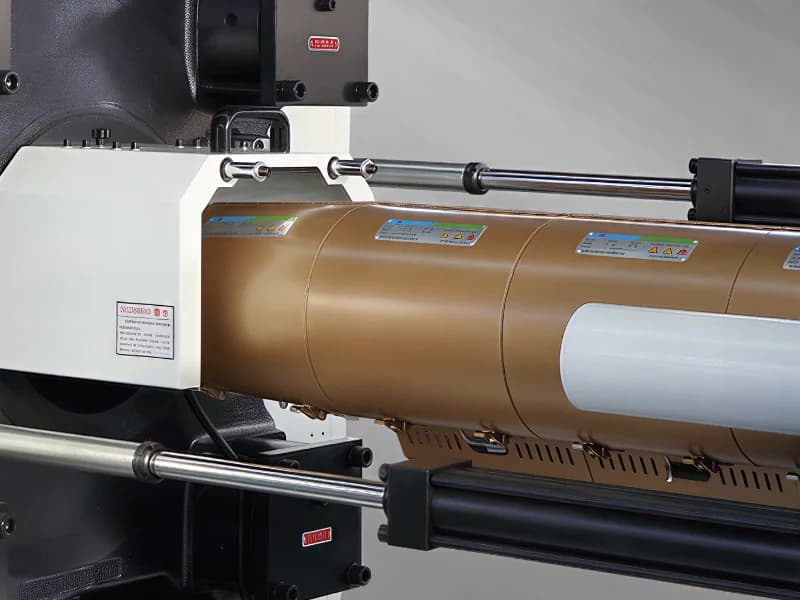
Servo-hydraulic drive system with energy recovery
Need Expert Advice?
Talk to our engineers about your specific production requirements. Free consultation.
Nucleating Agents and Clarifiers for Performance Enhancement
Additives modify base PP properties to meet specific application requirements. Nucleating agents (sodium benzoate, talc at 0.1-0.3 percent loading) increase crystallization rate by 20-40 percent, enabling cycle time reductions of 0.3-0.8s on HWAMDA SPV5 machines. The INOVA controller's adaptive cooling can optimize holding time based on the faster solidification profile. Sorbitol-based clarifiers (Millad NX8000 at 0.15-0.25 percent) reduce haze from 40-50 percent to 8-12 percent on 0.5mm wall sections, enabling transparent food containers that compete with PS and PET clarity while maintaining PP's microwave compatibility. For IML (In-Mold Labeling) applications, anti-static agents at 0.3-0.5 percent loading prevent label adhesion issues during label placement by the SWITEK IML robot -- static charge below 2kV is required for reliable label pick-up and placement. UV stabilizers (HALS at 0.1-0.3 percent) are necessary for packaging exposed to fluorescent lighting during retail display, preventing yellowing over the typical 6-12 month shelf life. All additives must be food-contact approved per FDA 21 CFR and EU 10/2011 with documented specific migration limits below thresholds.
Food Contact Regulatory Compliance by Market
PP resin for food packaging must comply with food contact regulations in every target market. The primary frameworks are: FDA 21 CFR 177.1520 (United States) -- PP is listed as a permitted polymer for food contact; compliance requires that additives are also listed under applicable regulations and that overall migration meets extraction limits. EU Regulation 10/2011 (European Union) -- PP must have an overall migration limit (OML) below 10 mg/dm2, with specific migration limits for individual substances. Testing per EN 1186 series is required. China GB 4806.6-2016 specifies migration testing under conditions simulating actual food contact (4 percent acetic acid at 70 degrees C for 2 hours for hot-fill applications). For export to the Middle East, Gulf Standards Organization GSO 1863:2013 references EU standards but may require additional halal certification for certain dairy packaging. HWAMDA SPV5 machines configured for food packaging production include stainless steel contact surfaces and food-grade hydraulic oil options to support customers' facility-level certifications. Always request a compliance declaration from the resin supplier specifying the exact regulation and test conditions.
Key Specs
- •China GB 4806.6-2016 specifies migration testing under conditions simulating actual food contact (4 percent acetic acid at 70 degrees C for 2 hours for hot-fill applications).
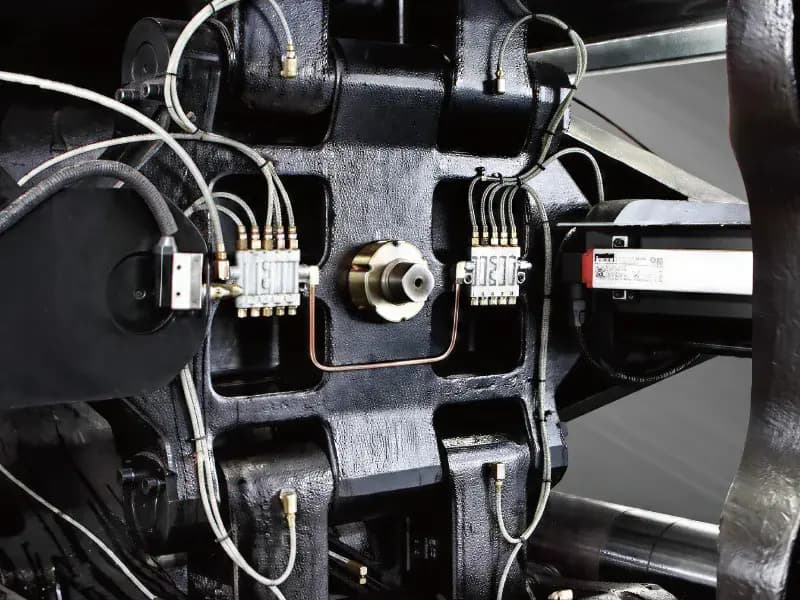
Toggle clamping unit — high rigidity for thin-wall molding
Material Drying, Handling, and Process Stability
PP is not hygroscopic and generally does not require pre-drying for thin-wall molding -- moisture content as received (typically below 0.05 percent) does not cause processing issues. However, if resin has been stored in uncontrolled environments with temperature cycling, condensation on pellet surfaces can cause splay marks on parts. In such cases, drying at 80-90 degrees C for 2-4 hours in a dehumidifying dryer reduces moisture below 0.02 percent. Material handling on HWAMDA SPV5 production lines should use a vacuum conveyor system with a stainless steel hopper to prevent contamination -- food packaging requires class 100,000 (ISO 8) or better cleanroom conditions at the machine environment level. The hopper capacity should hold 1-2 hours of production material: for an 8-cavity yogurt cup mold producing 6g cups at 4.0s cycle, material consumption is approximately 43 kg/hr, so a 50-80kg hopper is appropriate. Blend masterbatch directly above the machine feed throat using a gravimetric blender accurate to plus or minus 0.1 percent to ensure consistent color and additive dosing shot to shot.
Frequently Asked Questions
Use homo-PP with MFI 30-40 g/10min (230 degrees C/2.16kg) for 0.5mm wall yogurt cups. Grades like SABIC PP 575P (MFI 35) or Moplen HP548R (MFI 35) provide the optimal balance of flowability for filling 8-cavity molds on the HWAMDA HMD 380M8-SPV at 368 mm/s injection speed, while maintaining flexural modulus above 1,400 MPa for adequate stacking strength. MFI above 45 unnecessarily reduces part stiffness.
Related Guides
Ready to Start Your Project?
Get a free consultation and quotation for your thin-wall packaging production line.
Join 500+ manufacturers in 60+ countries who trust HWAMDA.
Get Free Quote