

Dimensional Measurement and Tolerances
Critical dimensions for thin-wall food containers include overall height, top and bottom diameter, wall thickness measured at multiple circumferential and vertical points, rim flatness for sealing, and lid-fit dimensions for snap-on or press-fit closure. Tolerances for injection-molded thin-wall containers are typically plus or minus 0.05 to 0.10 mm for critical dimensions like external diameter and overall height, and plus or minus 0.03 to 0.05 mm for wall thickness uniformity. Measurement methods include coordinate measuring machines (CMM) for comprehensive offline verification of sample parts against the full dimensional specification, optical comparators for rapid 2D profile checking at the production floor, and digital calipers and micrometers for operator spot checks during production runs. For wall thickness specifically, non-destructive measurement using Hall effect sensors or ultrasonic thickness gauges allows verification on finished parts without destructive sectioning. HWAMDA validates all critical dimensional tolerances during the structured T1, T2, and T3 mold trials and provides detailed dimensional reports with sample parts before mold shipment.
Key Specs
- •Tolerances for injection-molded thin-wall containers are typically plus or minus 0.05 to 0.10 mm for critical dimensions like external diameter and overall height, and plus or minus 0.03 to 0.05 mm for wall thickness uniformity.
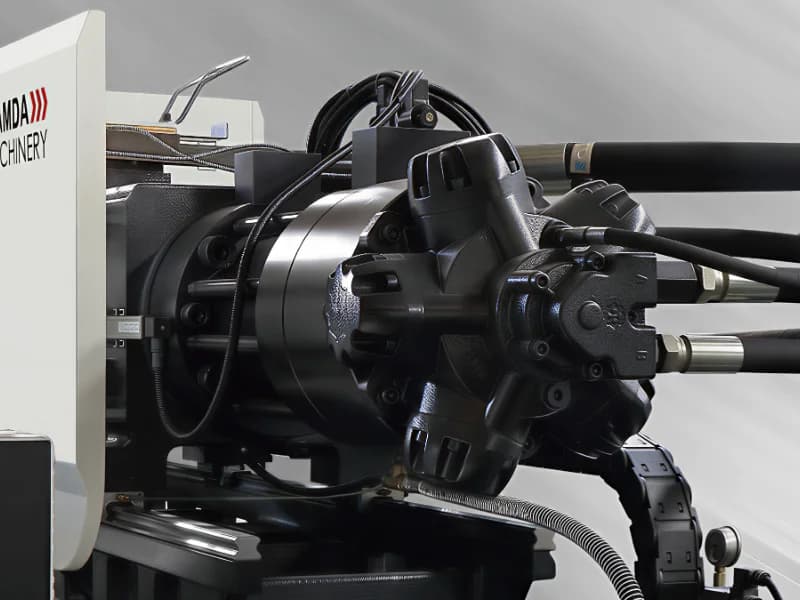
High-speed injection unit with linear guides
Weight Consistency Monitoring
Part weight is the most reliable single indicator of process stability in thin-wall molding because it reflects the combined effects of filling, packing, cooling, and material consistency. Target weight variation for thin-wall containers is plus or minus 1 to 2 percent of the nominal weight. For a 6-gram yogurt cup, this means each cup should weigh between 5.88 and 6.12 grams. Weight monitoring uses precision scales sampling individual parts at defined intervals, typically every 15 to 30 minutes during production. Automated weight monitoring systems can weigh every part and divert underweight or overweight parts to reject bins. Cavity-to-cavity weight analysis identifies individual cavities that are filling inconsistently, which may indicate a blocked cooling channel, worn valve pin, or runner imbalance. The HWAMDA INOVA controller logs shot-to-shot cushion position and peak pressure, both of which correlate with weight consistency and provide early warning of developing problems. Automated weight monitoring provides the most reliable quality assurance for high-speed thin-wall production.
Visual Defect Detection Systems
Vision inspection systems use high-resolution cameras and increasingly sophisticated machine learning algorithms to inspect 100 percent of produced parts in real time at production line speed. Camera stations are typically positioned at the robot extraction point or on the stacking conveyor, capturing multiple images of each part from different angles during normal production flow. Common defects detected by these systems include short shots where the cavity did not fill completely, flash at the parting line indicating clamping or mold issues, burn marks from trapped and compressed air, flow lines and weld lines on visible container surfaces, gate vestige defects, and IML label misalignment, wrinkling, or print defects. Modern AI-powered inspection systems from leading suppliers achieve detection rates above 99.5 percent with false reject rates below 0.5 percent, providing near-perfect quality screening. Leading vision system suppliers for packaging inspection include INTRAVIS, Beck Automation, and Cognex. A basic vision inspection station costs approximately 15,000 to 40,000 dollars for a thin-wall packaging line.
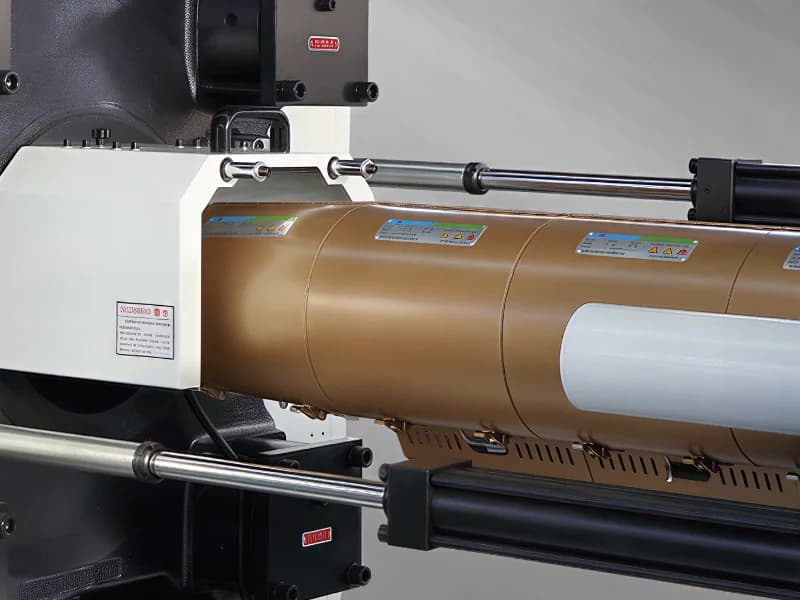
Servo-hydraulic drive system with energy recovery
Need Expert Advice?
Talk to our engineers about your specific production requirements. Free consultation.
Leak Testing and Seal Integrity
For containers that will be heat-sealed or fitted with snap-on lids, seal integrity is a critical quality parameter. Leak testing verifies that the container rim is flat, the lid-fit dimensions are within specification, and there are no defects in the container wall that could allow liquid or gas migration. Methods include pressure decay testing where the sealed container is pressurized and monitored for pressure loss, vacuum decay testing for detecting micro-leaks, and dye penetration testing for offline verification. For IML containers with tamper-evident features, functional testing of the tamper-evident lock mechanism is required to ensure it engages properly on the matching lid. HWAMDA validates seal compatibility during mold trials by producing sample containers and testing with the customer's sealing equipment or matching lid molds. Production-level leak testing is typically performed on a sampling basis of 1 to 5 percent of output. Seal integrity is a critical quality parameter for containers destined for hot-fill or modified atmosphere packaging applications.
Statistical Process Control (SPC)
SPC provides the mathematical framework for monitoring production quality and detecting process drift before out-of-specification parts are produced, moving quality control from reactive inspection to proactive prevention. Key SPC metrics for thin-wall packaging include Cpk (process capability index), targeting values of 1.33 or higher for all critical dimensions, which indicates the production process output is centered within specification limits with sufficient statistical margin. X-bar and R charts track the sample average and range of measured values over time, revealing trends or shifts in the process mean before they result in rejectable product. Individual measurement charts can monitor specific mold cavities for signs of progressive wear or developing defects. SPC data is collected through a combination of automatic weight monitoring, periodic dimensional sampling by quality control personnel, and process parameter logging from the INOVA controller. Modern production systems integrate SPC software directly with the machine controller, providing real-time quality dashboards visible to operators and automatic alerts when parameters approach statistical control limits.
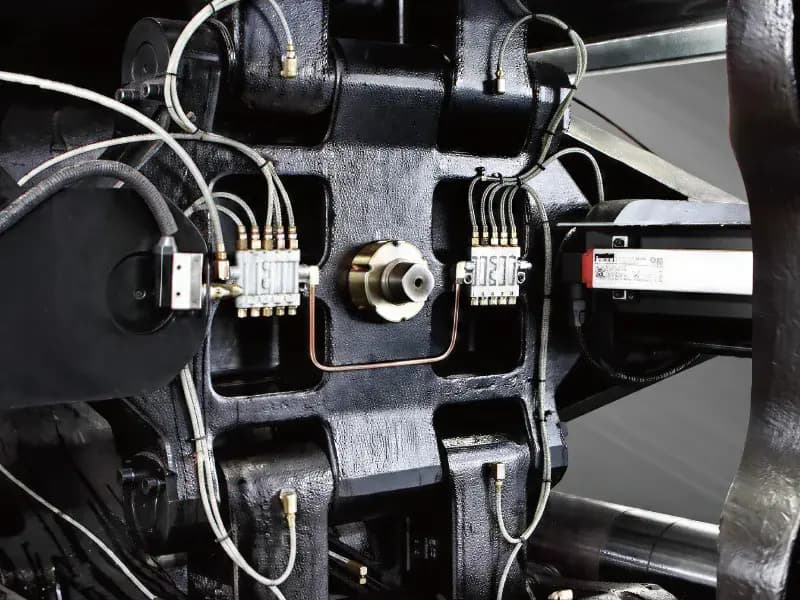
Toggle clamping unit — high rigidity for thin-wall molding
ISO and Food Safety Certifications
Thin-wall food packaging manufacturers typically pursue several certifications to qualify as approved suppliers to major food brands and retail chains. ISO 9001 (Quality Management System) is the baseline certification that demonstrates systematic production quality management processes. ISO 22000 or FSSC 22000 (Food Safety Management System) is increasingly required by food brand customers and retailers as a condition of supply for food-contact packaging. ISO 14001 (Environmental Management System) demonstrates documented commitment to environmental sustainability and is relevant for customers pursuing recyclable packaging claims in European markets. BRC/IOP (British Retail Consortium) Global Standard for Packaging and Packaging Materials is specifically required by UK retailers and many European retail chains for direct food packaging suppliers. HWAMDA provides equipment documentation and process validation support that assists customers in meeting the documentation requirements of these certification programs, including process monitoring data, material traceability records, and calibration certificates. Achieving these certifications opens doors to supply contracts with major multinational food companies and retail chains.
Frequently Asked Questions
The industry standard for thin-wall food containers is plus or minus 1 to 2 percent of nominal weight across all cavities. For a 6-gram yogurt cup, this means 5.88 to 6.12 grams. For a 15-gram milk tea cup, the range is 14.7 to 15.3 grams. Cavity-to-cavity variation should also be within this range. Weight variation outside these limits typically indicates a process problem such as runner imbalance, worn valve pin, or inconsistent material feed. The HWAMDA INOVA controller monitors cushion position as a proxy for shot-to-shot weight consistency.
Related Guides
Ready to Start Your Project?
Get a free consultation and quotation for your thin-wall packaging production line.
Join 500+ manufacturers in 60+ countries who trust HWAMDA.
Get Free Quote