

Screw Geometry Fundamentals for High-Speed Thin-Wall Processing
Thin-wall injection molding demands screws with specific geometric characteristics that differ significantly from general-purpose designs. The critical parameters are the length-to-diameter (L/D) ratio, compression ratio, and flight depth. For processing polypropylene at melt flow indices of 25-40 g/10min (230 degrees C/2.16kg), an L/D ratio of 22:1 to 25:1 provides sufficient residence time for complete melting without thermal degradation. The HWAMDA SPV5 screw designs use a 24:1 to 25:1 L/D ratio across the range -- the HMD 380M8-SPV uses a 55mm screw with 24:1 L/D, while the HMD 470M8-SPV steps up to a 60mm diameter at 24.5:1 L/D. Compression ratios of 2.5:1 to 3.0:1 are standard for PP thin-wall work, balancing melt homogeneity against excessive shear heating. Feed zone depth is typically 1.5-1.8 times the metering zone depth, ensuring consistent pellet intake. The metering zone should occupy 40-50 percent of the total screw length to maximize melt uniformity, which is essential when filling 8 or 16-cavity molds where cavity-to-cavity weight variation must remain below 2 percent.
Key Specs
- •The HWAMDA SPV5 screw designs use a 24:1 to 25:1 L/D ratio across the range -- the HMD 380M8-SPV uses a 55mm screw with 24:1 L/D, while the HMD 470M8-SPV steps up to a 60mm diameter at 24.5:1 L/D.
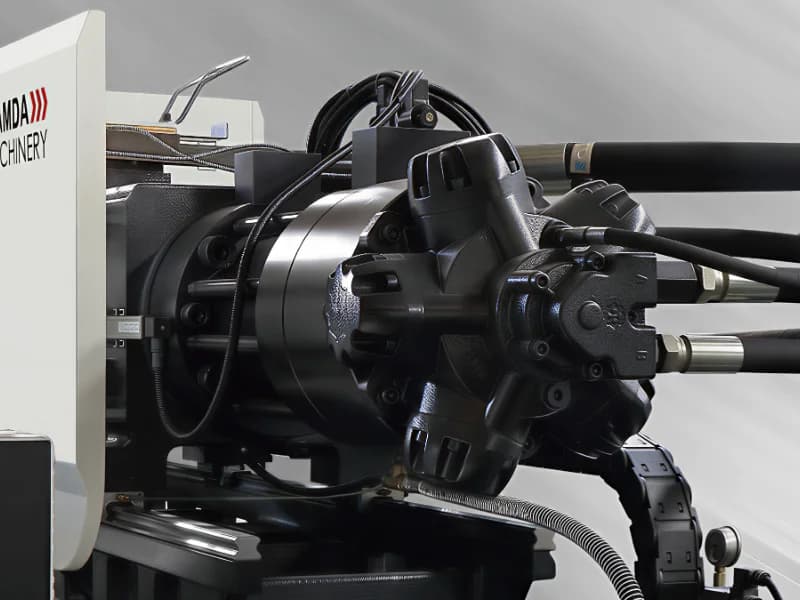
High-speed injection unit with linear guides
Barrel Specifications and Heating Zone Configuration
The barrel must complement the screw design with precise temperature control across multiple heating zones. For thin-wall PP processing, HWAMDA SPV5 machines employ 5 independently controlled heating zones along the barrel, plus a separate nozzle zone, with PID control accuracy of plus or minus 1 degree C. Typical zone settings for PP thin-wall molding are: feed zone 190-200 degrees C, compression zone 210-230 degrees C, metering zones 230-250 degrees C, and nozzle 240-260 degrees C. The barrel bore is nitrided to achieve a surface hardness of 65-70 HRC, with bore straightness tolerance of 0.02mm per 1000mm. For processing glass-fiber reinforced PP (10-30 percent GF), bimetallic barrels with a tungsten carbide alloy lining extend service life from approximately 8 million shots to over 20 million shots. The barrel ID-to-screw OD clearance is maintained at 0.05-0.08mm on diameter for the HMD 380M8-SPV's 55mm screw. Proper clearance prevents melt leakback during the injection phase, which is critical at injection pressures of 165-177 MPa typical in thin-wall filling.
Screw Selection by Product Application
Different thin-wall products require different screw specifications based on shot weight and cycle time demands. For yogurt cups (4-8g, 0.45-0.6mm wall), the HMD 380M8-SPV with a 55mm screw provides an injection volume of 640 cm3 and plasticizing rate of 38 g/s PP, sufficient for 8-cavity molds at 4.0-4.5s cycle times. For food containers (15-25g, 0.5-0.7mm wall), the HMD 470M8-SPV with a 60mm screw delivers 760 cm3 injection volume and 48 g/s plasticizing rate, supporting 4-cavity production at 5.0-6.0s cycles. Sauce cup production (2-4g, 0.35-0.5mm wall) on 16-cavity molds requires the HMD 330M8-SPV with a 52mm screw delivering 568 cm3 injection volume. The general rule is to size the shot weight at 30-70 percent of the barrel capacity to avoid excessive residence time, which causes PP degradation above 280 degrees C. Running a 6g x 8-cavity yogurt cup mold (48g shot plus 15g runner = 63g total) on a 640 cm3 barrel means approximately 56 percent utilization -- well within the optimal range.
Key Specs
- •For yogurt cups (4-8g, 0.45-0.6mm wall), the HMD 380M8-SPV with a 55mm screw provides an injection volume of 640 cm3 and plasticizing rate of 38 g/s PP, sufficient for 8-cavity molds at 4.0-4.5s cycle times.
- •For food containers (15-25g, 0.5-0.7mm wall), the HMD 470M8-SPV with a 60mm screw delivers 760 cm3 injection volume and 48 g/s plasticizing rate, supporting 4-cavity production at 5.0-6.0s cycles.
- •Sauce cup production (2-4g, 0.35-0.5mm wall) on 16-cavity molds requires the HMD 330M8-SPV with a 52mm screw delivering 568 cm3 injection volume.
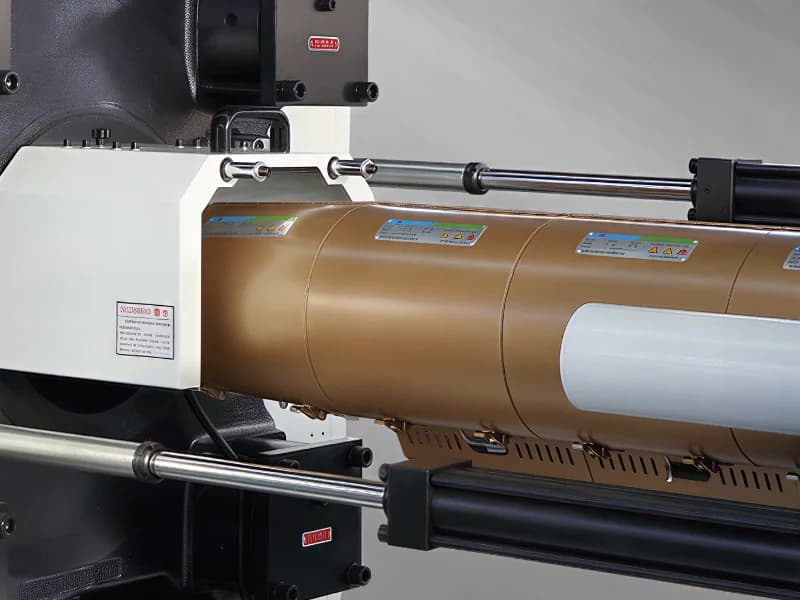
Servo-hydraulic drive system with energy recovery
Need Expert Advice?
Talk to our engineers about your specific production requirements. Free consultation.
Non-Return Valve Design for Shot Consistency
The non-return valve (check ring) at the screw tip is arguably the most critical component for thin-wall shot consistency. During injection at speeds of 368-422 mm/s, the valve must seal instantaneously to prevent melt backflow. A leaking check ring causes shot weight variation exceeding plus or minus 0.3g, which translates to visible wall thickness inconsistency on 0.5mm-wall containers. HWAMDA SPV5 machines use a 3-piece sliding ring check valve with lapped seating surfaces ground to a surface finish of Ra 0.2 micrometers. The ring-to-barrel clearance is held at 0.03-0.05mm on diameter. Valve response time is under 0.02 seconds at maximum injection speed. For high-speed yogurt cup production where cycle times are 3.5-4.5s, check ring wear should be inspected every 2 million shots and replaced when clearance exceeds 0.10mm. Worn check rings are the number one cause of weight scatter in thin-wall production, often misdiagnosed as process instability. A quick diagnostic is to run a purge shot in air and measure cushion consistency -- variation above 1.0mm indicates valve replacement is needed.
Barrel Wear Monitoring and Replacement Criteria
Barrel and screw wear in thin-wall production progresses faster than in conventional molding due to the higher back pressures (8-15 MPa) and screw speeds (150-250 RPM) required for adequate plasticizing rates. On HWAMDA SPV5 machines, the INOVA controller logs plasticizing time and cushion position data that can be trended to detect progressive wear. Key replacement indicators include: plasticizing time increase exceeding 15 percent from baseline, cushion variation greater than 1.5mm over 10 consecutive shots, and visible melt temperature inconsistency (more than 5 degrees C variation measured at the nozzle). For standard nitrided barrels processing unfilled PP, expected service life is 10-15 million shots. When processing PP with 20 percent calcium carbonate filler, barrel life drops to 5-8 million shots, making bimetallic upgrades cost-effective at approximately 40 percent higher initial cost but 2-3 times longer service intervals. HWAMDA recommends ultrasonic wall thickness measurement of the barrel at the feed section annually, replacing when wall thickness falls below 85 percent of the nominal specification.
Key Specs
- •Barrel and screw wear in thin-wall production progresses faster than in conventional molding due to the higher back pressures (8-15 MPa) and screw speeds (150-250 RPM) required for adequate plasticizing rates.
- •Key replacement indicators include: plasticizing time increase exceeding 15 percent from baseline, cushion variation greater than 1.5mm over 10 consecutive shots, and visible melt temperature inconsistency (more than 5 degrees C variation measured at the nozzle).
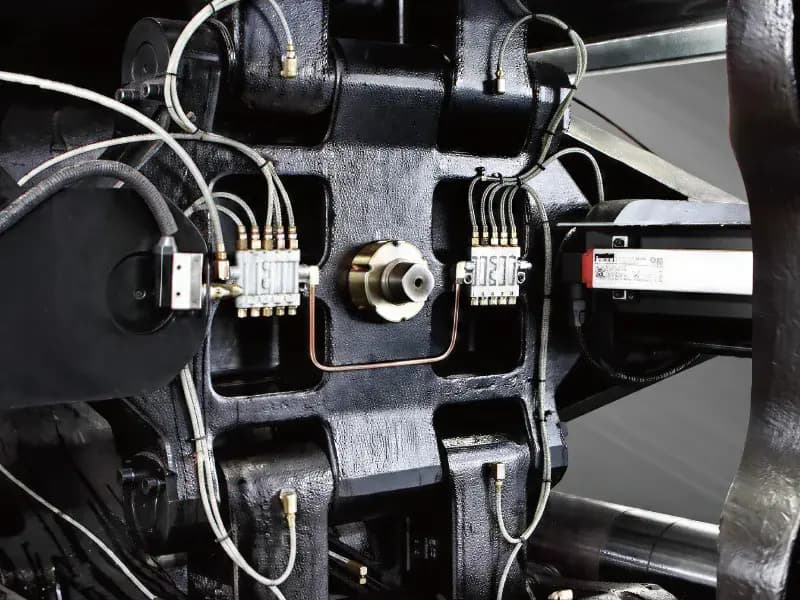
Toggle clamping unit — high rigidity for thin-wall molding
Optimizing Plasticizing Parameters for Cycle Time Reduction
Plasticizing efficiency directly impacts cycle time in thin-wall production because screw recovery must complete within the cooling phase. On the HWAMDA HMD 380M8-SPV producing 8-cavity yogurt cups at 4.0s cycle time, the available plasticizing window is approximately 2.0-2.5s (during mold cooling and part ejection). With a 63g total shot, the required plasticizing rate is 25-32 g/s, well within the 38 g/s capacity of the 55mm screw. Back pressure should be set at 8-12 MPa for standard PP to ensure melt homogeneity without extending recovery time. Screw RPM is typically 180-220 for PP with MFI 30-40, producing a melt temperature of 230-245 degrees C. Higher RPM generates more shear heat, which can be beneficial for rapid melting but risks thermal degradation if melt temperature exceeds 260 degrees C. The INOVA controller's charging-on-the-fly function begins screw recovery during mold opening, overlapping plasticizing with mold movement to recover an additional 0.3-0.5s per cycle. This feature alone can increase hourly output by 8-12 percent on yogurt cup production lines, translating to approximately 800-1,200 additional cups per hour on a 16-cavity setup.
Frequently Asked Questions
For thin-wall PP molding with MFI 25-40 g/10min, an L/D ratio of 23:1 to 25:1 provides optimal melt homogeneity. The HWAMDA SPV5 series uses 24:1 to 24.5:1 L/D across its range. Shorter L/D ratios below 22:1 produce inconsistent melt temperature, causing weight variation on multi-cavity molds. The compression ratio should be 2.5:1 to 3.0:1, with the metering zone occupying 40-50 percent of total screw length.
Related Guides
Ready to Start Your Project?
Get a free consultation and quotation for your thin-wall packaging production line.
Join 500+ manufacturers in 60+ countries who trust HWAMDA.
Get Free Quote