

Mono-Material Design for Recyclability
Mono-material packaging, where the entire package including labels and closures is made from a single polymer family, represents the gold standard for recyclability. Traditional multi-material packaging combining PP containers with paper labels and PE film lids creates sorting challenges at recycling facilities, often resulting in the entire package being sent to landfill. Mono-material PP design eliminates this problem entirely. In-Mold Labeling (IML) is the key enabling technology for mono-material PP packaging. By integrating PP-based labels directly into the container wall during molding, IML eliminates the need for adhesive-backed paper or film labels that contaminate the recycling stream. The label becomes an integral part of the container, and the entire package processes as a single PP stream at recycling facilities. HWAMDA's IML systems using SWITEK robots achieve precise label placement with cycle times of 5-7 seconds for margarine tubs and food containers, making mono-material production commercially viable without sacrificing output rates or shelf presentation quality.
Key Specs
- •HWAMDA's IML systems using SWITEK robots achieve precise label placement with cycle times of 5-7 seconds for margarine tubs and food containers, making mono-material production commercially viable without sacrificing output rates or shelf presentation quality.
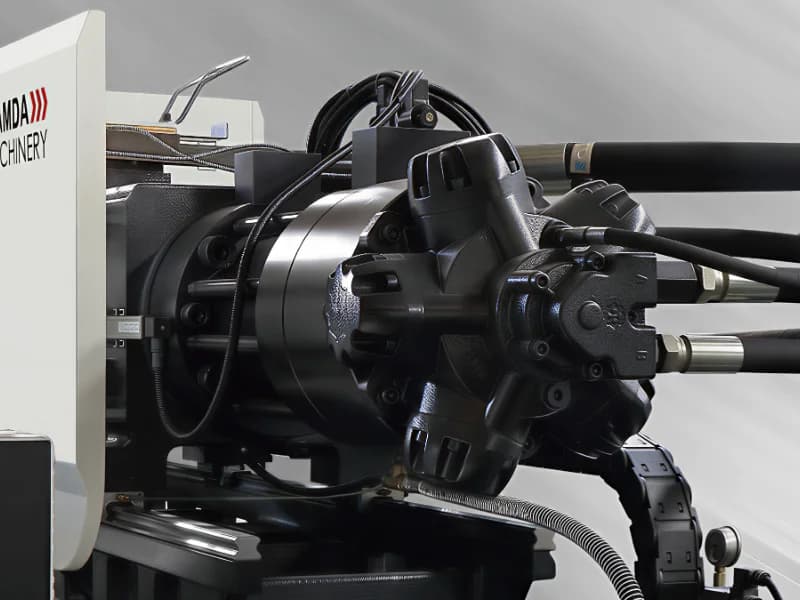
High-speed injection unit with linear guides
PP as a Sustainable Packaging Material
Polypropylene stands out among packaging polymers for its combination of sustainability credentials and practical performance. PP is fully recyclable through mechanical recycling processes, retaining sufficient mechanical properties through multiple recycling loops for non-food applications. Its density of 0.9 g/cm3, the lowest among common packaging polymers, means less material by weight for equivalent container volumes compared to PET or PS alternatives. PP's excellent chemical resistance ensures food safety without requiring barrier coatings or multi-layer structures that compromise recyclability. For food packaging specifically, PP offers FDA and EU food-contact compliance in virgin form, heat resistance for hot-fill applications up to 100 degrees C, and compatibility with microwave reheating. HWAMDA's SPV5 machines are optimized for PP processing, with screw designs featuring the correct compression ratio and L/D ratio for consistent melt quality. The machines process standard food-grade PP resins with melt flow indices of 30-60 g/10min, specifically formulated for thin-wall packaging applications requiring high flowability.
Reducing Material Use Through Thin-Wall Design
Thin-wall injection molding delivers immediate sustainability benefits through source reduction, using less material per container without compromising structural performance. A standard 500 mL food container with 1.2 mm wall thickness weighs approximately 18-22 grams, while an optimized thin-wall version at 0.5-0.6 mm wall thickness achieves the same volume at just 8-12 grams. This 40-55% weight reduction translates directly to lower raw material consumption, reduced transportation emissions, and decreased end-of-life waste volume. HWAMDA SPV5 machines enable these material savings through precise process control. The servo-hydraulic injection system maintains shot weight repeatability within plus or minus 0.3 grams, ensuring thin walls remain structurally sound without over-packing that wastes material. For yogurt cups running on SPV5-380 machines with 12-cavity molds at 3.5-4.5 second cycle times, the consistent filling process produces cups with uniform 0.45 mm wall thickness while consuming 35-40% less PP resin than conventional molding approaches. Over a production year of 60 million cups, this saves approximately 180-240 tonnes of PP resin.
Key Specs
- •A standard 500 mL food container with 1.2 mm wall thickness weighs approximately 18-22 grams, while an optimized thin-wall version at 0.5-0.6 mm wall thickness achieves the same volume at just 8-12 grams.
- •This 40-55% weight reduction translates directly to lower raw material consumption, reduced transportation emissions, and decreased end-of-life waste volume.
- •For yogurt cups running on SPV5-380 machines with 12-cavity molds at 3.5-4.5 second cycle times, the consistent filling process produces cups with uniform 0.45 mm wall thickness while consuming 35-40% less PP resin than conventional molding approaches.
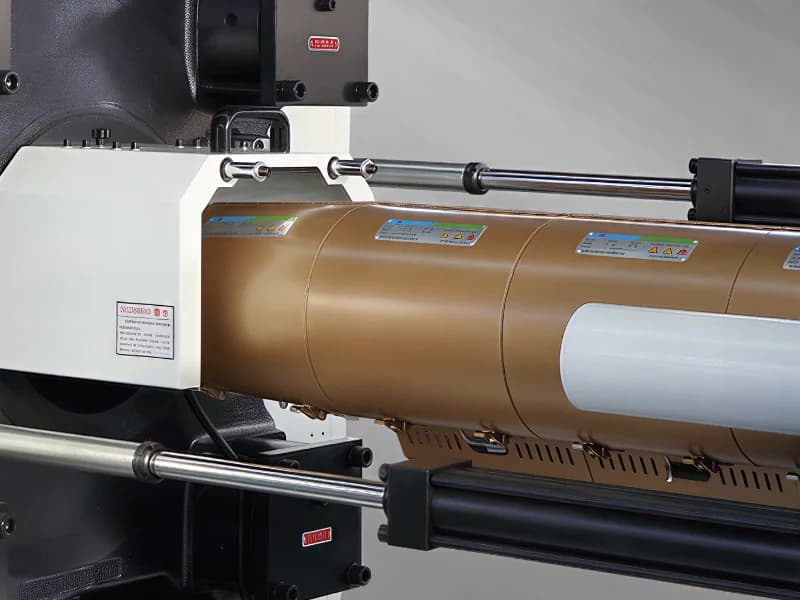
Servo-hydraulic drive system with energy recovery
Need Expert Advice?
Talk to our engineers about your specific production requirements. Free consultation.
Circular Economy in Food Packaging
The circular economy model for food packaging aims to keep materials in productive use through continuous recycling loops rather than the traditional linear produce-use-dispose pathway. Achieving circularity in PP food packaging requires coordination across the value chain, from resin producers offering recycling-compatible grades through to collection and sorting infrastructure. European EPR (Extended Producer Responsibility) schemes now assign lower fees to mono-material, easily recyclable packaging, creating direct financial incentives for converters investing in thin-wall IML production technology. HWAMDA's turnkey production lines support circular economy goals at every stage. The efficient SPV5 machines minimize energy consumption per container, while precision mold designs reduce scrap rates below 1%. In-mold labeling eliminates separate labeling processes and adhesive waste. Automated take-out robots and stacking systems reduce handling damage, further minimizing material waste. For manufacturers entering PP food packaging markets with sustainability mandates, HWAMDA offers complete production lines from 270T machines for sauce cups up to 600T systems for yogurt pails, all engineered for mono-material PP production.
Sustainability Regulations and Market Trends
The regulatory landscape for packaging sustainability is tightening globally, with the EU's PPWR establishing the most ambitious framework. By 2030, all plastic packaging placed on the EU market must be recyclable by design, with specific recycling rate targets of 55% by 2030 and 65% by 2035. The PPWR also sets minimum recycled content requirements: 10% by 2030 and 35% by 2040 for contact-sensitive packaging. Similar regulations are emerging in other markets: Turkey, Saudi Arabia, and the UAE are adopting sustainability frameworks modeled on EU standards, while Brazil and Mexico are strengthening their own packaging waste regulations. For food packaging manufacturers, these regulations create both compliance requirements and market opportunities. Companies investing now in mono-material PP production lines with IML capability position themselves ahead of regulatory deadlines. HWAMDA clients across the Middle East, Africa, and Latin America are increasingly specifying IML-equipped turnkey lines to meet anticipated regulations while gaining competitive advantages through premium packaging presentation that mono-material IML enables.
Key Specs
- •By 2030, all plastic packaging placed on the EU market must be recyclable by design, with specific recycling rate targets of 55% by 2030 and 65% by 2035.
- •The PPWR also sets minimum recycled content requirements: 10% by 2030 and 35% by 2040 for contact-sensitive packaging.
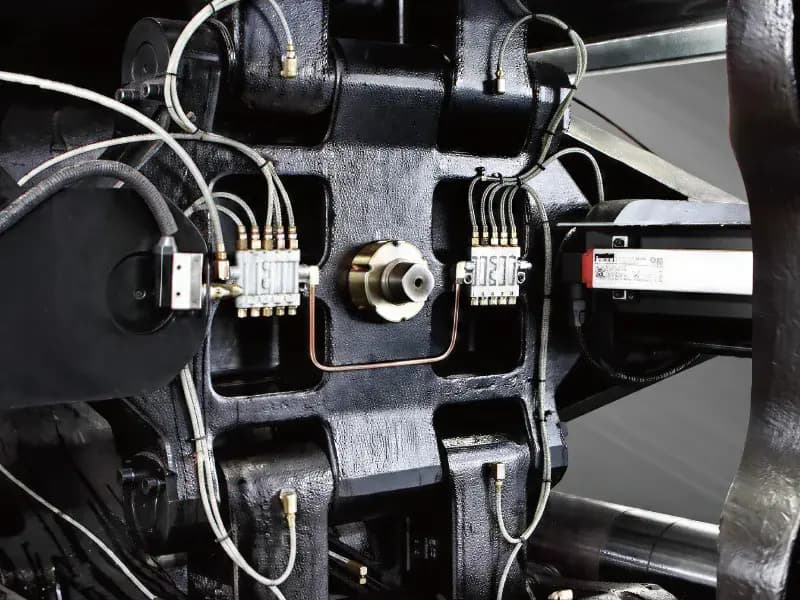
Toggle clamping unit — high rigidity for thin-wall molding
HWAMDA Equipment for Sustainable Packaging
HWAMDA's equipment portfolio directly addresses every aspect of sustainable food packaging production. The SPV5 series from 270T to 600T covers the full range of thin-wall PP packaging applications, from small sauce cups to large yogurt pails, all optimized for minimal material consumption through precise process control. Energy efficiency is built into the servo-hydraulic drive system, which reduces electricity consumption by 40-60% compared to standard hydraulic machines, contributing to lower carbon footprints per container produced. For mono-material IML production, HWAMDA integrates SWITEK robotic systems with SPV5 machines and purpose-built IML molds. The SPV5-380 IML configuration produces margarine tubs in 4-6 cavity molds at 5-7 second cycles, with PP labels fused permanently into container walls during molding. This eliminates post-mold labeling processes, reducing both energy use and waste generation. HWAMDA's turnkey approach includes material handling, mold temperature control, and downstream automation, ensuring every component works together for maximum efficiency. Manufacturers targeting European, Middle Eastern, or Latin American markets benefit from equipment that meets sustainability requirements while maintaining competitive production economics.
Frequently Asked Questions
Thin-wall molding reduces environmental impact through source reduction, using 35-50% less PP resin per container compared to conventional molding. A yogurt cup at 0.45 mm wall thickness weighs 8-10 grams versus 16-20 grams for a standard-wall version. This material reduction lowers raw material extraction, processing energy, transportation emissions, and end-of-life waste volume. HWAMDA SPV5 machines further contribute through 40-60% energy savings from servo-hydraulic drives compared to standard hydraulic systems. Over a production year of 60 million cups, thin-wall molding saves approximately 180-240 tonnes of PP resin.
Related Guides
Ready to Start Your Project?
Get a free consultation and quotation for your thin-wall packaging production line.
Join 500+ manufacturers in 60+ countries who trust HWAMDA.
Get Free Quote