

PP: The Most Common Choice
Polypropylene is the default material for thin-wall food packaging, used for over 60% of injection molded food containers globally. Its advantages include: heat resistance to 100°C+ for hot-fill and microwave applications, excellent chemical resistance to acids, bases, and fats, FDA 21 CFR §177.1520 and EU 10/2011 food contact compliance, good moisture barrier properties, and lightweight density of 0.90 g/cm³ minimizing material cost per container. For thin-wall molding, specify high-flow PP grades with MFI of 40-80 g/10 min (230°C/2.16 kg). Leading grades include Borealis BH348MO, SABIC PP 578N, and LyondellBasell Moplen HP548R. PP is compatible with IML decoration—the standard for branded dairy containers. HWAMDA SPV5 machines are optimized for PP processing with screw designs and temperature profiles calibrated for high-flow PP thin-wall grades. PP cost of $1,100-1,400/ton makes it the most economical choice for most applications. HWAMDA SPV5 machines are optimized for PP processing with screw designs and temperature profiles calibrated for high-flow thin-wall grades, delivering optimal melt quality and processing efficiency.
Key Specs
- •Polypropylene is the default material for thin-wall food packaging, used for over 60% of injection molded food containers globally.
- •Its advantages include: heat resistance to 100°C+ for hot-fill and microwave applications, excellent chemical resistance to acids, bases, and fats, FDA 21 CFR §177.1520 and EU 10/2011 food contact compliance, good moisture barrier properties, and lightweight density of 0.90 g/cm³ minimizing material cost per container.
- •For thin-wall molding, specify high-flow PP grades with MFI of 40-80 g/10 min (230°C/2.16 kg).
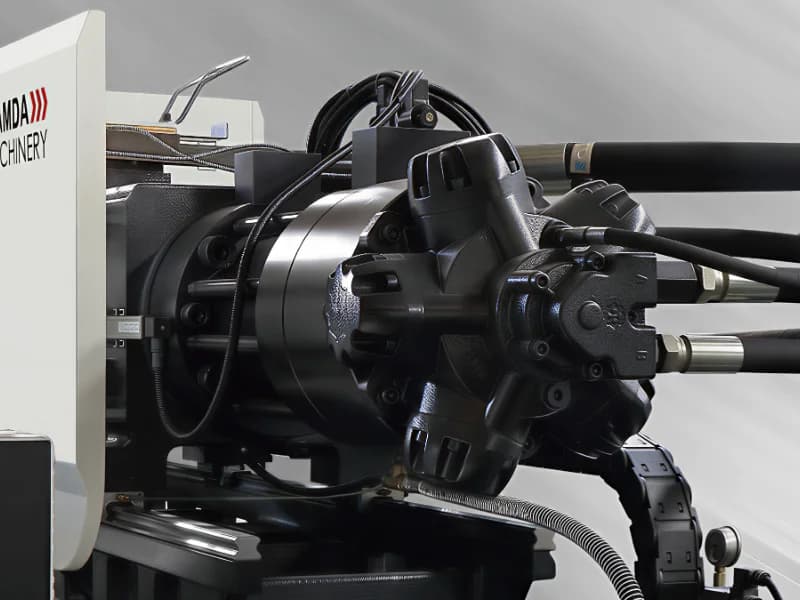
High-speed injection unit with linear guides
PS: For Rigid Clear Containers
General-purpose polystyrene (GPPS) offers the highest clarity of any commodity plastic, with light transmittance exceeding 88%, making it ideal for transparent containers where product visibility is essential. GPPS is preferred for deli containers, salad bowls, and clear food trays. High-impact polystyrene (HIPS) adds rubber modification for improved toughness at the cost of transparency. PS processes at 180-280°C melt temperature with lower injection pressure than PP, enabling faster cycle times and simpler tooling. MFI of 10-30+ g/10 min (200°C/5 kg) provides excellent flow for multi-cavity molds. PS shrinkage of 0.4-0.7% is lower and more predictable than PP's 1.0-2.5%, improving dimensional accuracy. However, PS has regulatory challenges—the EU Single-Use Plastics Directive and various national regulations restrict PS for food service items. New investments in PS food packaging carry regulatory risk. PS is processed on HWAMDA SPV5 270-280T machines for tableware and deli containers. However, the global regulatory trend strongly favors PP replacement of PS for food packaging, making PP processing capability the more future-proof investment for new manufacturing operations.
PET: For Premium Transparent Cups
PET (polyethylene terephthalate) delivers crystal clarity rivaling glass, with light transmittance above 90%. It is the premium material for cold beverage cups—milk tea cups, juice cups, smoothie cups—where visual appeal is paramount. PET also offers excellent gas barrier properties, making it suitable for oxygen-sensitive food products. PET injection molding for thin-wall containers requires careful moisture control—resin must be dried to below 50 ppm moisture to prevent hydrolysis that causes haze and brittleness. Processing temperature of 270-290°C is higher than PP, increasing energy costs. PET's density of 1.38 g/cm³ (53% heavier than PP) increases material cost per container despite similar per-ton pricing. PET is not suitable for hot-fill applications above 65°C in its amorphous form. For beverage cup production, HWAMDA SPV5 450T machines with appropriate screw design handle PET processing effectively. For beverage cup production, HWAMDA SPV5 450T machines with appropriate screw design handle PET processing effectively, though dedicated drying equipment must be included in the production line.
Key Specs
- •PET (polyethylene terephthalate) delivers crystal clarity rivaling glass, with light transmittance above 90%.
- •Processing temperature of 270-290°C is higher than PP, increasing energy costs.
- •PET's density of 1.38 g/cm³ (53% heavier than PP) increases material cost per container despite similar per-ton pricing.
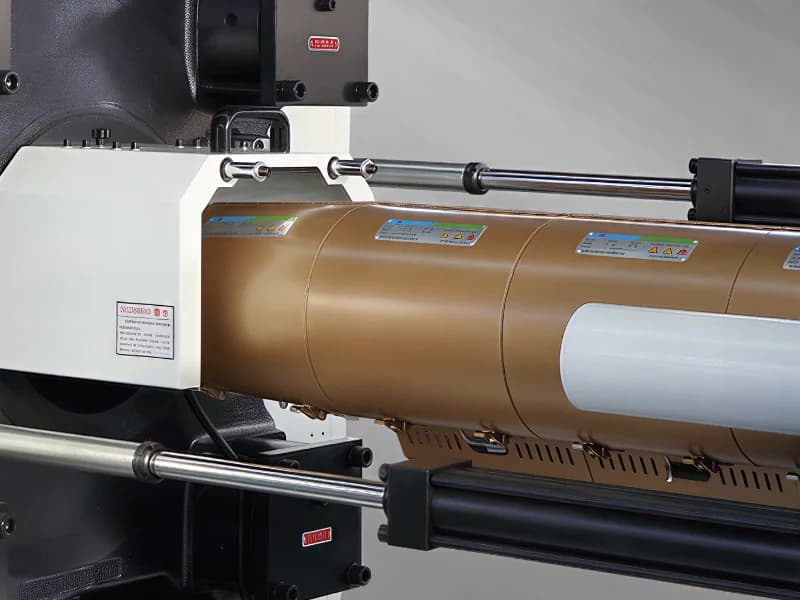
Servo-hydraulic drive system with energy recovery
Need Expert Advice?
Talk to our engineers about your specific production requirements. Free consultation.
EVOH and Barrier Materials
EVOH (ethylene vinyl alcohol) provides exceptional oxygen barrier properties—up to 1,000 times better than PP alone. It is used as a barrier layer in multi-layer container structures for products requiring extended shelf life, such as dairy products, sauces, and ready meals. EVOH cannot be used alone; it must be incorporated as an inner layer in PP/EVOH/PP structures. Multi-layer thin-wall containers require co-injection or barrier injection molding technology—a specialized technique where two materials are injected sequentially to create a sandwich structure. This technology adds significant equipment cost ($50,000-100,000 for co-injection capability) and process complexity. Single-material PP containers with adequate shelf life (2-4 weeks for dairy) remain the standard for most food packaging applications. Barrier containers are justified only for products requiring 3+ month shelf life or hermetic oxygen exclusion. HWAMDA can advise on barrier container feasibility for specific shelf-life requirements. Single-material PP containers with adequate shelf life of 2-4 weeks for refrigerated dairy remain the standard for most food packaging, with barrier technology reserved for specialized applications.
Material Cost Comparison
PP: $1,100-1,400/ton, density 0.90 g/cm³, material cost per 150ml cup approximately $0.010-0.014. PP offers the lowest per-container material cost due to its low density and competitive pricing. PS: $1,000-1,300/ton, density 1.04-1.06 g/cm³, material cost per equivalent container approximately $0.011-0.016. Slightly cheaper per ton but higher density increases per-unit cost by 15-20%. PET: $1,000-1,300/ton, density 1.38 g/cm³, material cost per equivalent container approximately $0.015-0.022. The highest per-container cost due to high density, despite similar per-ton pricing. PET also requires drying equipment adding $15,000-30,000 capital cost and $0.001-0.002 per container in processing cost. EVOH: $4,000-6,000/ton as barrier layer, adding $0.005-0.015 per container in material cost. For most food packaging applications, PP delivers the best balance of properties and cost. For most food packaging applications, PP delivers the best balance of material properties, processing ease, regulatory compliance, and cost per container among all available polymer options. Regional material availability should also be considered. PP resin is available globally from multiple suppliers, while specialty PET and EVOH grades may have limited sources in some markets.
Key Specs
- •Slightly cheaper per ton but higher density increases per-unit cost by 15-20%.
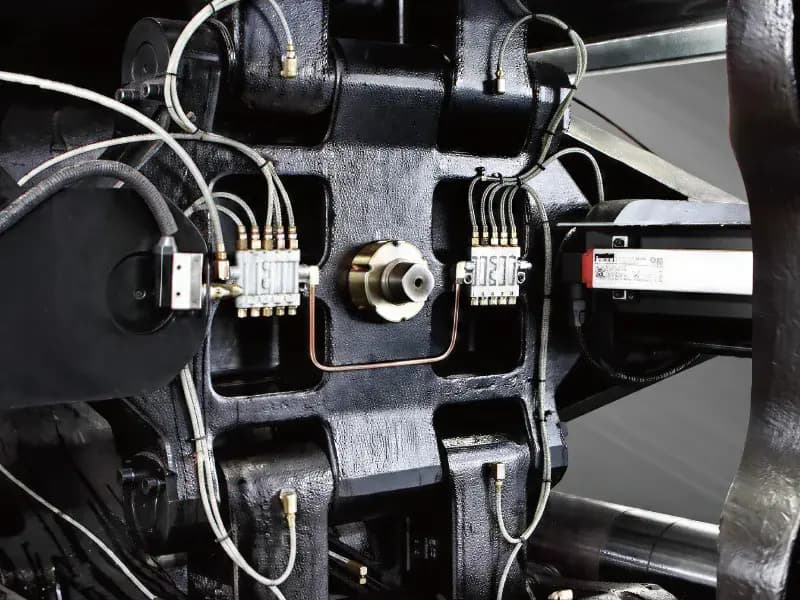
Toggle clamping unit — high rigidity for thin-wall molding
Food Safety Compliance by Material
PP: Fully compliant with FDA 21 CFR §177.1520, EU Regulation 10/2011, and virtually all national food contact regulations worldwide. PP is approved for all food contact conditions including hot-fill, microwave, and freezer. No concerns about monomer migration or endocrine disruptors. PP is the safest regulatory choice for new food packaging products. PS: Compliant with FDA 21 CFR §177.1640 and EU 10/2011 with restrictions. Residual styrene monomer must remain below 0.5% by weight. Not recommended for hot fatty food contact above 70°C. Increasing regulatory restrictions on single-use PS in many markets. PET: Compliant with FDA 21 CFR §177.1630 and EU 10/2011. Low migration risk when used below 65°C. Acetaldehyde migration is the primary concern for taste-sensitive products. For all materials, use only certified food-grade resin from reputable suppliers and maintain clean-room production practices. HWAMDA provides material specification guidance for specific market compliance requirements. Maintaining separate material handling and storage systems for each polymer prevents cross-contamination that can cause processing problems and food safety compliance issues.
Frequently Asked Questions
PP (polypropylene) is the best material for yogurt cups. It offers heat resistance for hot-fill processes up to 100°C, excellent chemical resistance to dairy fats and acids, full FDA and EU food contact compliance, microwave compatibility for consumer convenience, and compatibility with IML decoration for branded packaging. High-flow PP grades with MFI of 40-60 g/10 min are recommended. HWAMDA SPV5 380-400T machines are specifically optimized for PP yogurt cup production with 8-16 cavity molds. Specify high-flow grades with MFI of 40-60 for optimal thin-wall processing on HWAMDA SPV5 machines.
Related Guides
Ready to Start Your Project?
Get a free consultation and quotation for your thin-wall packaging production line.
Join 500+ manufacturers in 60+ countries who trust HWAMDA.
Get Free Quote