

Understanding Clamping Force and Tonnage
Clamping force, measured in metric tons or kilonewtons, is the force holding the mold closed during injection. Insufficient clamping causes flash (thin plastic leaking at the parting line), while excessive tonnage wastes energy and accelerates mold wear. For thin-wall packaging, calculate required clamping force as projected area (cm2) multiplied by cavity pressure (400-600 kg/cm2 for PP thin-wall). A 12-cavity yogurt cup mold with 50 cm2 per cavity needs approximately 300-360 tons, matching the HWAMDA SPV5 380T specification. Food containers with larger projected areas require 480-530T. Sauce cups use smaller projected areas but higher cavitation (16-32 cavities), requiring 270-280T. Always add a 10-15% safety margin above calculated requirements. The HWAMDA SPV5 series offers 270T to 600T, covering all thin-wall food packaging applications.
Key Specs
- •A 12-cavity yogurt cup mold with 50 cm2 per cavity needs approximately 300-360 tons, matching the HWAMDA SPV5 380T specification.
- •Sauce cups use smaller projected areas but higher cavitation (16-32 cavities), requiring 270-280T.
- •Always add a 10-15% safety margin above calculated requirements.
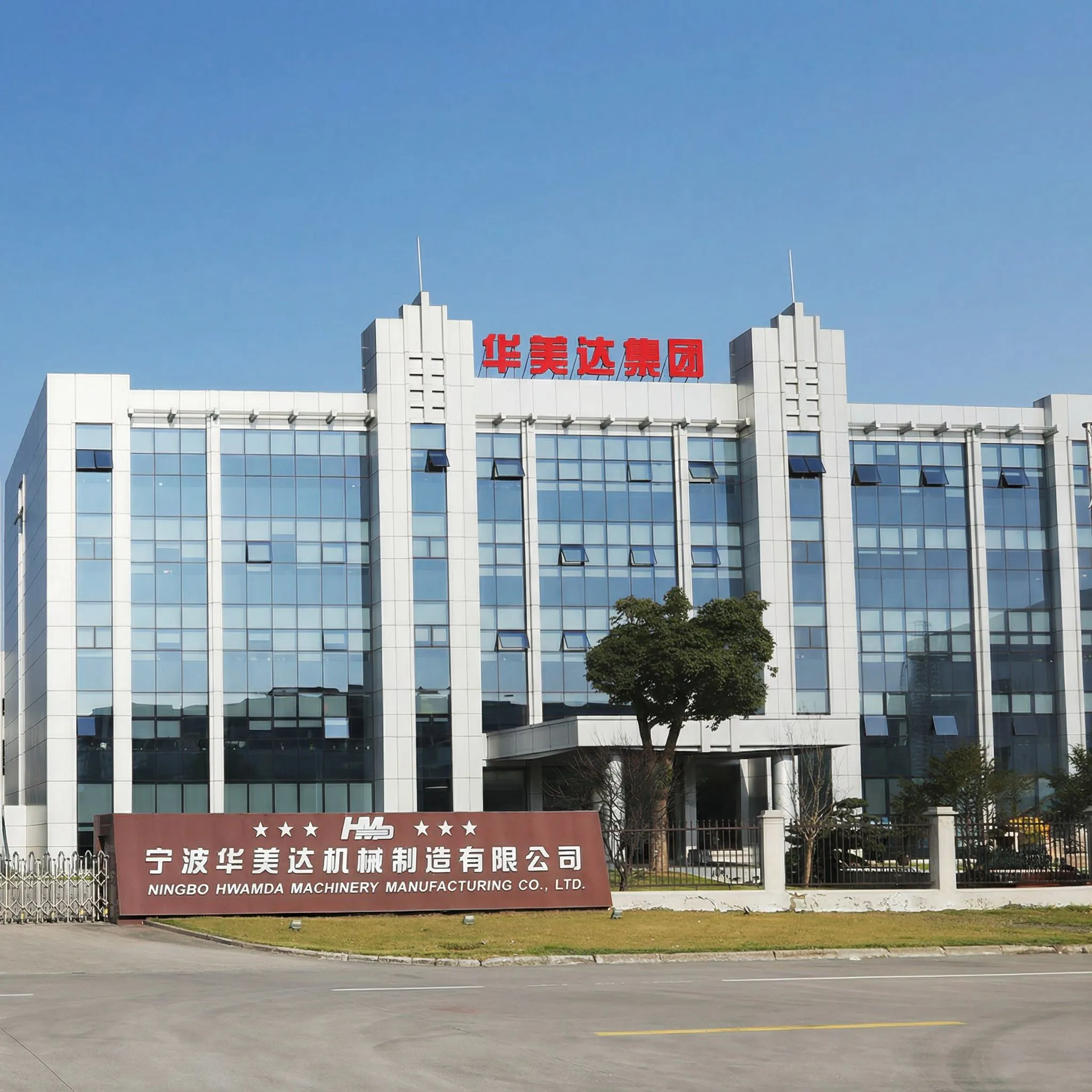
HWAMDA factory — quality manufacturing since 2003
Injection Volume and Shot Weight
Injection volume (cm3) and shot weight (grams) define the maximum material the machine can inject per cycle. Total shot weight must equal combined weight of all cavities plus runner system (zero for hot runner molds). For thin-wall applications, target 40-80% barrel utilization per shot for optimal melt quality. Under 30% utilization causes material degradation from excessive residence time, while over 85% risks incomplete filling. The HWAMDA SPV5 380T offers dual screw options: 60mm screw with 432g shot weight or 65mm screw with 465g capacity. For a 12-cavity yogurt cup mold producing 6-gram cups (72g total), the 60mm screw provides ideal utilization with hot runner. For food containers at 30g each in 6-cavity configuration (180g shot), the SPV5 480T with appropriately sized screw delivers the right barrel utilization. Always verify shot weight calculations before selecting machine specifications.
Injection Speed and Pressure Ratings
Injection speed (mm/s) is the most critical specification for thin-wall molding. Thin walls freeze rapidly, requiring fast injection to fill the cavity before the melt front solidifies. For wall thicknesses below 0.6mm, speeds of 400-500mm/s are essential. The HWAMDA SPV5 series delivers 450-517mm/s, with the SPV5-270 and SPV5-280 achieving 500mm/s+ for high-cavitation sauce cups and tableware. Injection pressure (MPa) must push melt through thin flow paths against rapidly increasing resistance. Thin-wall applications require 160-200 MPa. The SPV5 series offers 169-200 MPa depending on screw diameter. When comparing specifications, ensure injection speed is measured at rated pressure, not zero load. Some manufacturers quote maximum speed under no-load conditions, which drops significantly under actual pressures. HWAMDA specifies injection speed at full operating pressure for realistic comparison.
Key Specs
- •For wall thicknesses below 0.6mm, speeds of 400-500mm/s are essential.
- •The HWAMDA SPV5 series delivers 450-517mm/s, with the SPV5-270 and SPV5-280 achieving 500mm/s+ for high-cavitation sauce cups and tableware.
- •Thin-wall applications require 160-200 MPa.
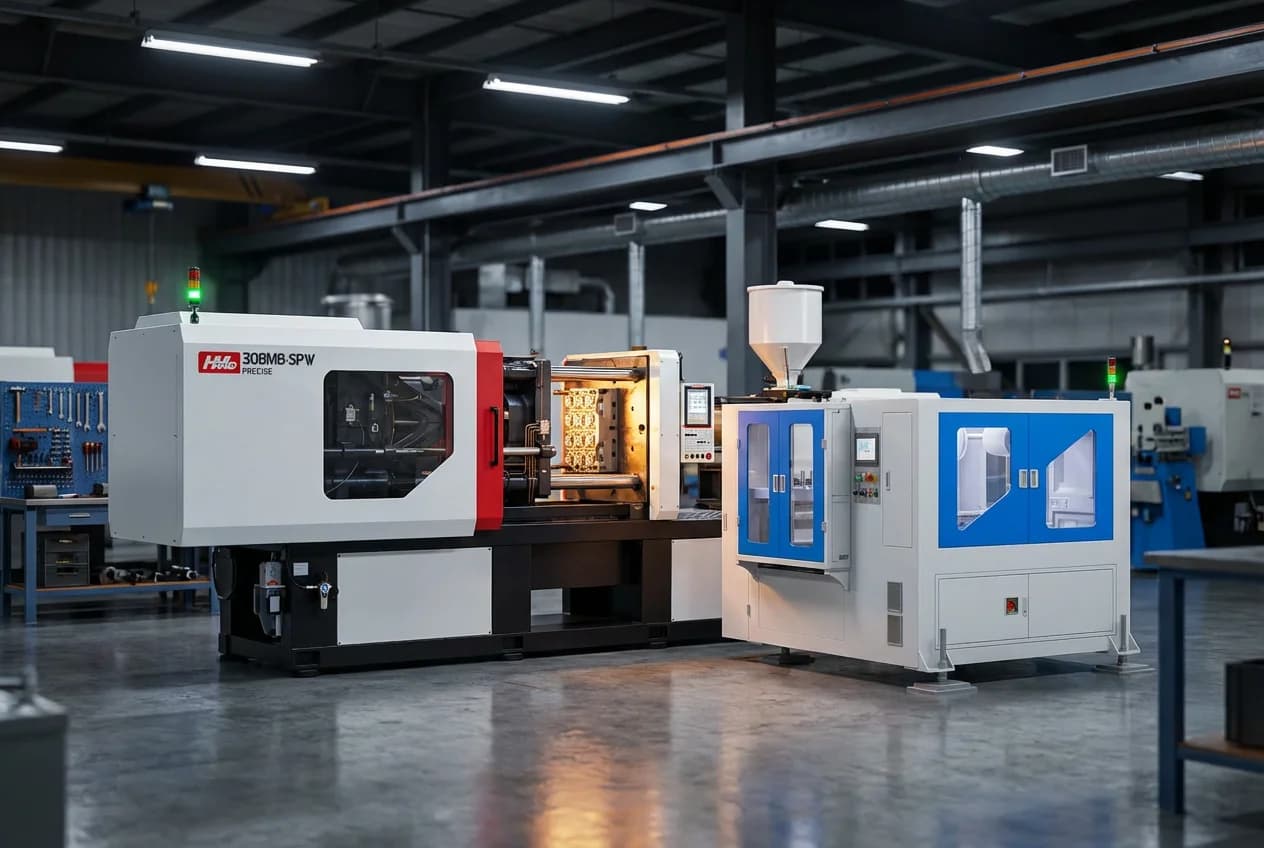
SPV5 machines on the production floor
Need Expert Advice?
Talk to our engineers about your specific production requirements. Free consultation.
Platen Size and Tie Bar Spacing
Platen dimensions and tie bar spacing determine the maximum mold size your machine can accommodate. For multi-cavity thin-wall molds, tie bar spacing is often the limiting factor rather than clamping force. A 12-cavity yogurt cup mold typically requires a mold base of 600x500mm, while a 16-cavity sauce cup mold needs 500x450mm. The HWAMDA SPV5 380T provides platen dimensions of 910x860mm with tie bar spacing of 610x560mm, comfortably accommodating up to 16-cavity yogurt cup molds. The SPV5 480T offers 1040x960mm platens with 710x660mm tie bar spacing for food container molds. Always verify that your planned mold fits within tie bar spacing with adequate clearance for mounting hardware. Platen parallelism is equally important: the SPV5 series maintains parallelism within 0.03mm, ensuring uniform clamping pressure across all cavities for consistent wall thickness in multi-cavity production.
Dry Cycle Time and Machine Response
Dry cycle time measures how fast the machine can open, eject, and close without mold or material. It represents the machine's mechanical speed limit and is a key indicator of thin-wall suitability. For production targeting 3-5 second total cycles, dry cycle time should be under 2.0 seconds. The HWAMDA SPV5 series achieves 1.6-1.9 seconds depending on tonnage, with smaller machines at the faster end. Machine response time, the delay between control signal and hydraulic reaction, directly impacts cycle consistency. The SPV5 servo-hydraulic system provides response times under 40 milliseconds, enabling precise repeatability. When comparing machines, request cycle time breakdown data showing actual injection, cooling, mold open/close, and ejection times for your specific application. HWAMDA provides detailed cycle time analyses with each quotation, verified by mold trial data from actual production runs.
Key Specs
- •For production targeting 3-5 second total cycles, dry cycle time should be under 2.0 seconds.
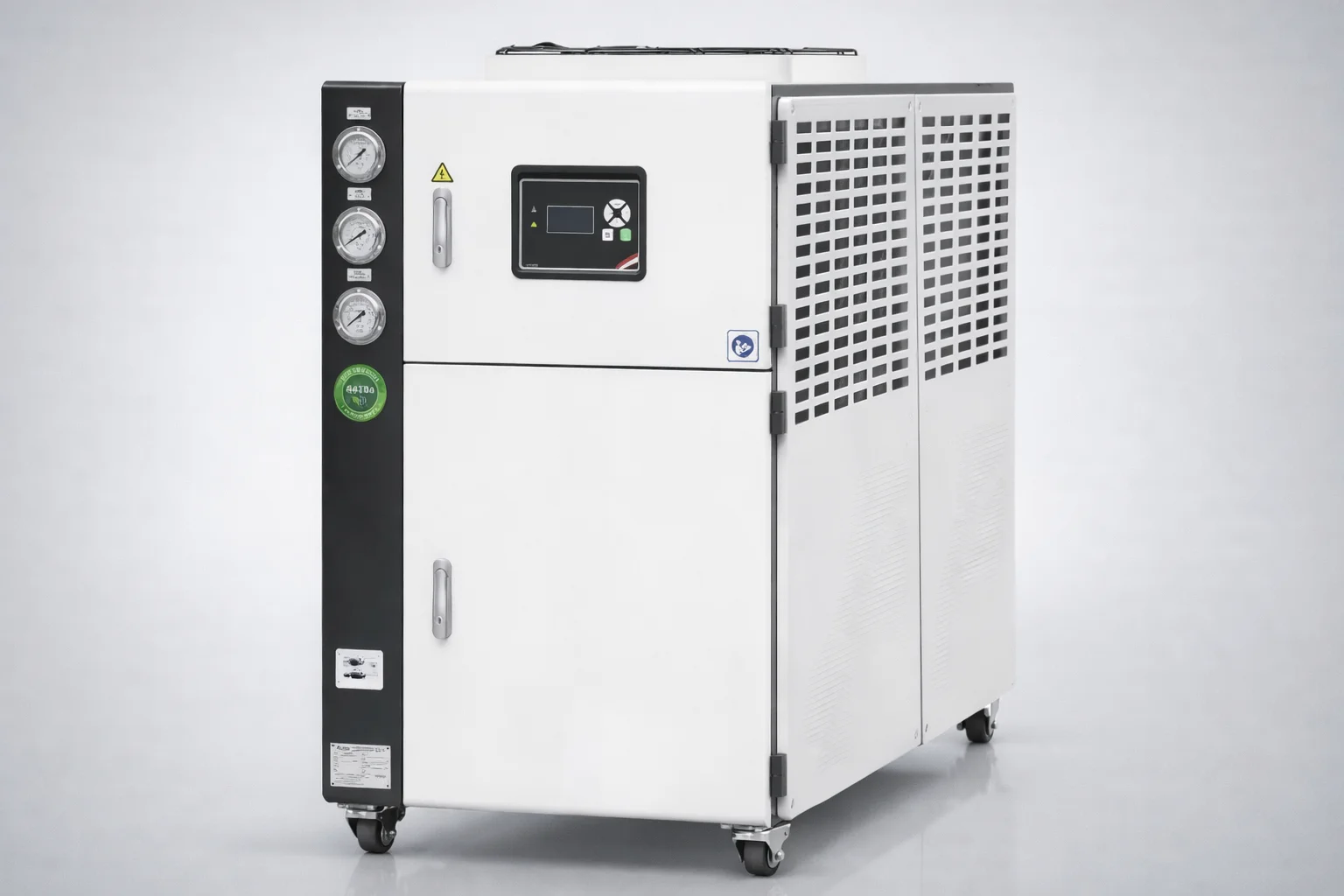
Industrial cooling system for injection molding
Power Consumption and Efficiency Ratings
Energy consumption significantly impacts operating costs, especially where electricity exceeds $0.10 per kWh. Compare machines using specific energy consumption (SEC) in kWh per kilogram of processed material. Conventional fixed-pump machines typically consume 0.8-1.2 kWh/kg, while servo-hydraulic machines like the HWAMDA SPV5 consume 0.35-0.55 kWh/kg, a 40-60% reduction. The SPV5 380T with dual 55kW servo pump motors has maximum connected power of approximately 140 kW but actual production consumption averages 15-22 kWh per hour for yogurt cups. Compare this to fixed-pump machines consuming 30-40 kWh/hour. At $0.10/kWh running 7,200 hours annually, the SPV5 saves $5,400-$12,600 per year per machine. Over 10 years, energy savings alone can exceed $50,000. Look for variable-speed servo pump drives, proportional valve control, and barrel insulation that collectively minimize energy waste.
Frequently Asked Questions
For wall thicknesses of 0.4-0.6mm typical in food packaging, injection speeds of 400-517mm/s are required to fill cavities before the melt front freezes. The HWAMDA SPV5 series delivers 450-517mm/s across its tonnage range. Lower injection speeds result in short shots, flow marks, and inconsistent wall thickness. Always verify that quoted speeds are measured under actual molding pressure, not zero-load conditions, as real-world speed under pressure determines filling performance.
Related Guides
Ready to Start Your Project?
Get a free consultation and quotation for your thin-wall packaging production line.
Join 500+ manufacturers in 60+ countries who trust HWAMDA.
Get Free Quote