

Material Cost Calculation
Material cost is the largest component at 45-65% of total production cost. Formula: Material cost per part = Part weight (g) x PP price ($/kg) / 1,000. For a 6g PP yogurt cup with PP at $1.30/kg: material cost = 6 x 1.30 / 1,000 = $0.0078 per cup. Adjust for material waste: hot runner molds have zero runner waste, but add 1-3% for start-up purging, color changes, and rejected parts. Adjusted material cost = $0.0078 x 1.02 = $0.00796. For IML containers, add label cost: $0.008-0.015 per label from Chinese suppliers. Total material cost for IML yogurt cup: $0.0078 + $0.010 = $0.0178. Material cost varies significantly by PP grade: standard homopolymer $1.10-1.35/kg, random copolymer $1.15-1.50/kg, high-MFI specialty grades $1.30-1.80/kg. Regional PP pricing also varies: Asia $1.10-1.30/kg, Middle East $1.20-1.40/kg, Europe $1.30-1.60/kg, Africa $1.40-1.70/kg (import premium). Reducing part weight by 0.5g (from 6.0g to 5.5g by optimizing wall from 0.42mm to 0.38mm) saves $0.00065 per cup, or $29,900 annually on 46 million cup production.
Key Specs
- •Material cost is the largest component at 45-65% of total production cost.
- •Adjust for material waste: hot runner molds have zero runner waste, but add 1-3% for start-up purging, color changes, and rejected parts.
- •Reducing part weight by 0.5g (from 6.0g to 5.5g by optimizing wall from 0.42mm to 0.38mm) saves $0.00065 per cup, or $29,900 annually on 46 million cup production.
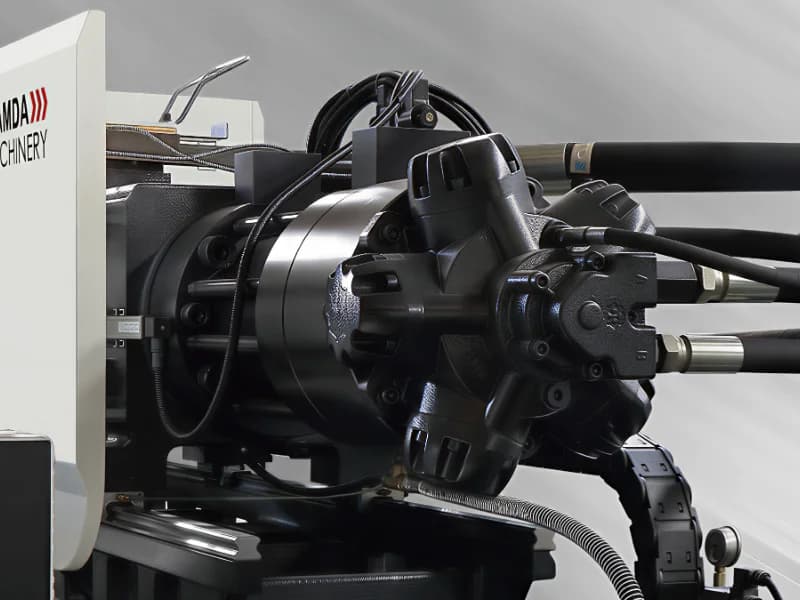
High-speed injection unit with linear guides
Energy Cost Per Part
Energy cost formula: Energy per part = Machine power consumption (kWh/kg) x Part weight (kg) x Electricity rate ($/kWh) / Cavities. For the HWAMDA HMD 400M8-SPV consuming 1.0 kWh/kg of PP, producing 6g parts in 8 cavities: first calculate per-cycle energy: the machine consumes approximately 25-30 kW average during thin-wall production. At 4.5s cycle time (800 cycles/hour), energy per cycle = 30 kW / 800 cycles/hr = 0.0375 kWh/cycle. Energy per part = 0.0375 / 8 cavities = 0.00469 kWh. At $0.08/kWh (typical Asian industrial rate): energy cost per part = 0.00469 x $0.08 = $0.000375. At $0.12/kWh (Middle East): $0.000563. At $0.15/kWh (Europe): $0.000703. Energy represents only 2-5% of total production cost, making it less significant than material or labor in most regions. However, running 24/7 on an HMD 400M8-SPV, annual energy cost totals $21,600-37,800, making the SPV5's servo-hydraulic efficiency (0.95-1.1 kWh/kg vs 1.5 kWh/kg for standard hydraulic) worth $8,000-15,000 annually.
Labor Cost Allocation
Modern thin-wall production lines are highly automated but still require operator oversight. Labor model: one operator monitors 2-4 HWAMDA SPV5 machines, handling material loading, quality checks, packaging, and basic troubleshooting. For a single machine cell, allocate 0.5 operator (shared with another machine). Labor cost per part = (Operator hourly rate / Parts per hour) x Operators per machine. In China: $5-8/hr operator rate, 6,400 parts/hr (8-cavity, 4.5s): ($7 / 6,400) x 0.5 = $0.000547/part. In Southeast Asia: $3-6/hr: ($4.5 / 6,400) x 0.5 = $0.000352/part. In Middle East: $4-10/hr: ($7 / 6,400) x 0.5 = $0.000547/part. In Europe: $20-35/hr: ($27.5 / 6,400) x 0.5 = $0.00215/part. Add supervisory and maintenance labor at approximately 30% of operator cost. Fully loaded labor cost ranges from $0.0005 (low-cost regions) to $0.003 (Europe) per part, representing 3-15% of total production cost. Automation reduces labor dependency: fully automated IML lines with robotic palletizing can operate with 0.25 operator per machine, halving the labor cost component.
Key Specs
- •Add supervisory and maintenance labor at approximately 30% of operator cost.
- •Fully loaded labor cost ranges from $0.0005 (low-cost regions) to $0.003 (Europe) per part, representing 3-15% of total production cost.
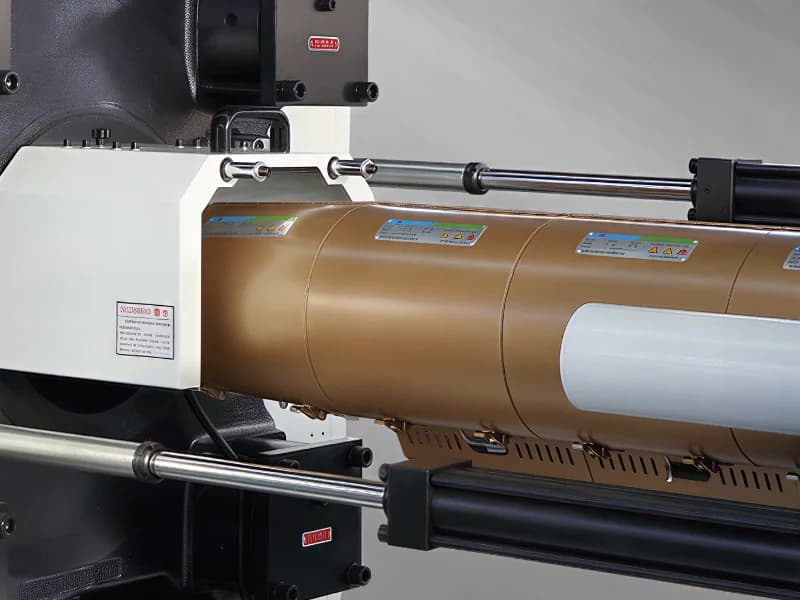
Servo-hydraulic drive system with energy recovery
Need Expert Advice?
Talk to our engineers about your specific production requirements. Free consultation.
Machine and Mold Amortization
Machine amortization formula: Machine cost per part = Machine investment / (Annual production x Amortization years). HWAMDA HMD 400M8-SPV at $92,000, producing 46 million cups/year (8-cavity, 4.5s, 24/7, 85% OEE), amortized over 5 years: $92,000 / (46,000,000 x 5) = $0.000400/part. Over 7 years: $0.000286/part. Over 10 years: $0.000200/part. Mold amortization: 8-cavity yogurt cup mold at $45,000 with 5 million cycle life, producing 8 parts per cycle: $45,000 / (5,000,000 x 8) = $0.001125/part. If mold lasts 3 million cycles: $0.001875/part. Robot amortization: SWITEK IML robot at $35,000 over 7 years and 322 million parts: $0.000109/part. Auxiliary equipment at $35,000 over 7 years: $0.000109/part. Total equipment amortization: $0.0017-0.0027 per part, representing 10-15% of total production cost. Note: amortization is a non-cash cost used for pricing decisions. For cash flow analysis, use actual debt service or lease payments instead. Equipment financed at 6-8% interest adds approximately 30-50% to the amortization cost.
Overhead, Quality, and Packaging Costs
Overhead costs include facility rent, insurance, management, quality control, and packaging. Factory overhead: $3-8/m2/month for production space. A single HWAMDA SPV5 cell occupies 100-120 m2, costing $300-960/month or $3,600-11,520/year. Per part: $3,600 / 46,000,000 = $0.0001-0.0003. Quality control: incoming material inspection, in-process monitoring (weight checks every 30 minutes, dimensional checks every 2 hours), and final inspection. Budget 1 quality technician per 4-8 machines at $6-30/hr. Per part: $0.0002-0.0005. Packaging: cups are stacked in sleeve-wrapped columns of 25-50, placed in corrugated cartons. Packaging material cost: $0.001-0.003 per cup for cartons, films, and palletizing. Insurance and administration: 2-3% of total manufacturing cost. Total overhead: $0.002-0.005 per part, representing 10-20% of total cost. The sum is significantly affected by regional factors: Southeast Asian operations achieve overhead as low as $0.002/part while European facilities reach $0.005-0.008/part.
Key Specs
- •Insurance and administration: 2-3% of total manufacturing cost.
- •Total overhead: $0.002-0.005 per part, representing 10-20% of total cost.
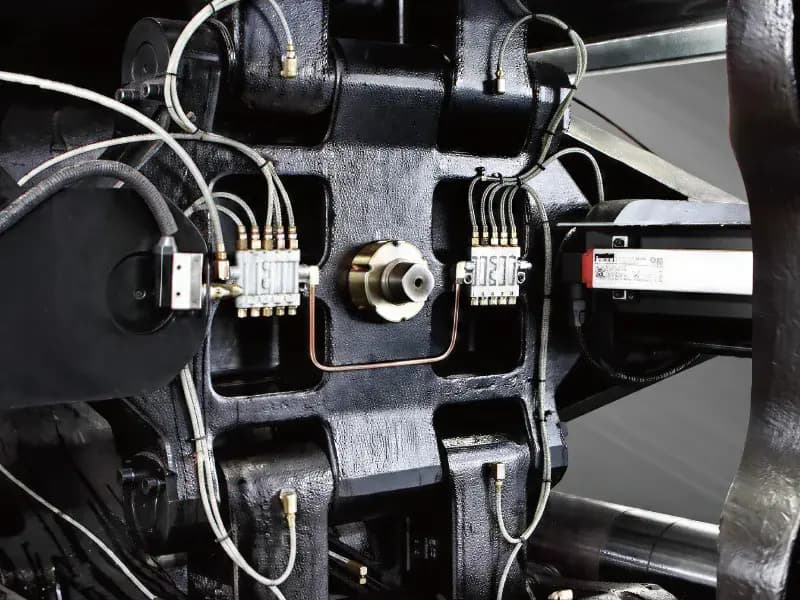
Toggle clamping unit — high rigidity for thin-wall molding
Complete Cost Model and Profit Margin Analysis
Consolidating all cost components for a 6g PP yogurt cup with IML label, produced on HWAMDA HMD 400M8-SPV, 8-cavity, 4.5s cycle, in a Southeast Asian facility. Material (PP): $0.0080. Material (IML label): $0.0100. Energy: $0.0004. Labor: $0.0005. Machine amortization: $0.0004. Mold amortization: $0.0013. Robot amortization: $0.0001. Auxiliary amortization: $0.0001. Overhead and packaging: $0.0030. Total production cost: $0.0238/cup. Typical selling price for IML yogurt cups: $0.035-0.055. Gross margin: $0.011-0.031/cup (32-57%). For non-IML cups (subtract $0.010 label cost), production cost drops to $0.0138/cup with selling price of $0.020-0.035, maintaining 31-61% gross margin. At 46 million cups annual production, total revenue: $1.61-2.53 million (IML) or $920,000-1.61 million (non-IML). Annual gross profit: $506,000-1.43 million (IML) or $285,000-993,000 (non-IML). These economics demonstrate why HWAMDA SPV5 production lines generate rapid payback: the $170,000-200,000 total cell investment returns its cost within 2-5 months of 24/7 IML production.
Frequently Asked Questions
On an HWAMDA HMD 400M8-SPV with 8-cavity mold at 4.5s cycle: PP material $0.0078 (6g at $1.30/kg), IML label $0.008-0.015, energy $0.0004, labor $0.0005-0.003 (region-dependent), equipment amortization $0.0019, overhead $0.002-0.005. Total: $0.012-0.015 without IML or $0.020-0.030 with IML. The largest cost driver is material (40-65%), making wall thickness optimization the most impactful cost reduction lever.
Related Guides
Ready to Start Your Project?
Get a free consultation and quotation for your thin-wall packaging production line.
Join 500+ manufacturers in 60+ countries who trust HWAMDA.
Get Free Quote