Iraq Food Packaging Market Overview
Iraq's food packaging market is valued at approximately USD 3.2 billion in 2025, with rigid plastic packaging growing at 7 to 9% CAGR as the country's manufacturing sector rebuilds and modernizes. The country's GDP of approximately USD 270 billion, driven by oil revenues, supports a young population of 43 million with a median age of 20 years and rapid urbanization. Iraq's dairy sector is experiencing strong growth, with domestic production supplemented by significant imports from Turkey, Iran, Saudi Arabia, and the UAE. Major local dairy producers including Al-Junaidi, Al-Rasheed, Pinar Iraq (Turkish joint venture), and Baghdad Dairy are investing in modern packaging to compete with imported products. The Iraqi government's industrial development strategy encourages domestic manufacturing to reduce import dependency, with customs exemptions available for production equipment. PP resin is imported primarily from Saudi Arabia, Iran, and Turkey at prices of approximately USD 1,100 to 1,350 per metric ton CIF Umm Qasr. Chinese machinery dominates Iraq's packaging equipment imports, with established brand recognition from over two decades of trade. Baghdad, Erbil, Sulaymaniyah, and Basra are the primary industrial centers for food packaging production.
Key Specs
- •Iraq's food packaging market is valued at approximately USD 3.2 billion in 2025, with rigid plastic packaging growing at 7 to 9% CAGR as the country's manufacturing sector rebuilds and modernizes.
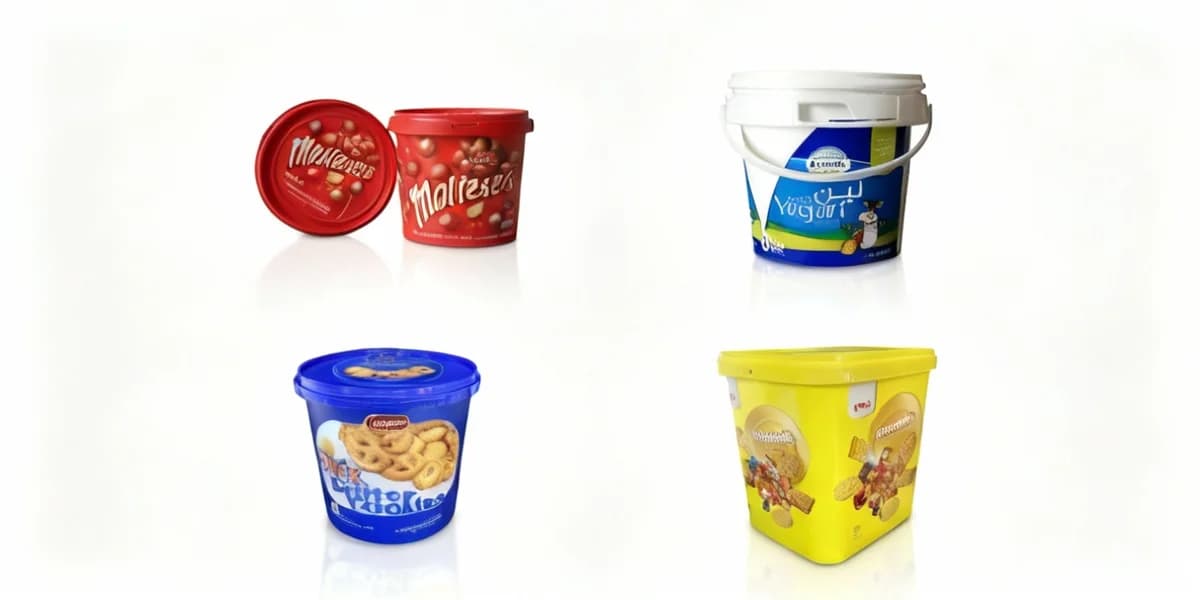
Complete yogurt pail production line with IML
Key Opportunities: Yogurt Pail Sector
Iraq's yogurt pail market is estimated at 400 to 600 million units annually, covering yogurt, laban (drinking yogurt), gaymer, and labneh in formats ranging from 1 to 5 liters. The 1-liter and 2-liter round pails with snap-fit or tamper-evident lids are the dominant formats, reflecting Iraqi household purchasing patterns of daily dairy consumption in family sizes. Part weights range from 25 to 45 grams at 0.6 mm wall thickness in food-grade PP. The Kurdistan Region of Iraq (KRI), with its more developed retail infrastructure including Family Mall, Majidi Mall, and local supermarket chains, is driving the adoption of IML-decorated dairy packaging. Baghdad and Basra markets, while still largely traditional, are transitioning rapidly as modern retail expands. Iraqi consumers show strong preference for locally produced dairy products in attractive packaging over imported alternatives, creating opportunities for converters who invest in IML capability. The competitive landscape for packaging equipment in Iraq is dominated by Chinese and Turkish suppliers, with European brands having limited presence due to price sensitivity and after-sales support challenges.
Import Regulations and Certification Requirements
Injection molding machines enter Iraq under HS code 8477.10, with import duties varying between federal Iraq (typically 5 to 8% on CIF value) and the Kurdistan Region of Iraq which may apply different tariff schedules. VAT in Iraq is currently minimal at 0 to 5% depending on the product category and importing region. Industrial equipment imports benefit from customs exemptions under the Iraqi Investment Law No. 13 of 2006, which provides duty-free importation for production equipment used in licensed investment projects. Food-contact packaging materials should comply with Iraqi standards (IQS) which reference international Codex Alimentarius guidelines, though enforcement varies by region. CE certification on HWAMDA machines is recognized and valued by Iraqi importers. The Kurdistan Region generally has more streamlined customs procedures through the Ibrahim Khalil border crossing from Turkey or via Umm Qasr port. HWAMDA provides documentation in English and Arabic as required, including commercial invoices, packing lists, certificates of origin, and technical specifications. Customs clearance at Umm Qasr port typically requires 7 to 14 working days.
Key Specs
- •Injection molding machines enter Iraq under HS code 8477.10, with import duties varying between federal Iraq (typically 5 to 8% on CIF value) and the Kurdistan Region of Iraq which may apply different tariff schedules.
- •VAT in Iraq is currently minimal at 0 to 5% depending on the product category and importing region.
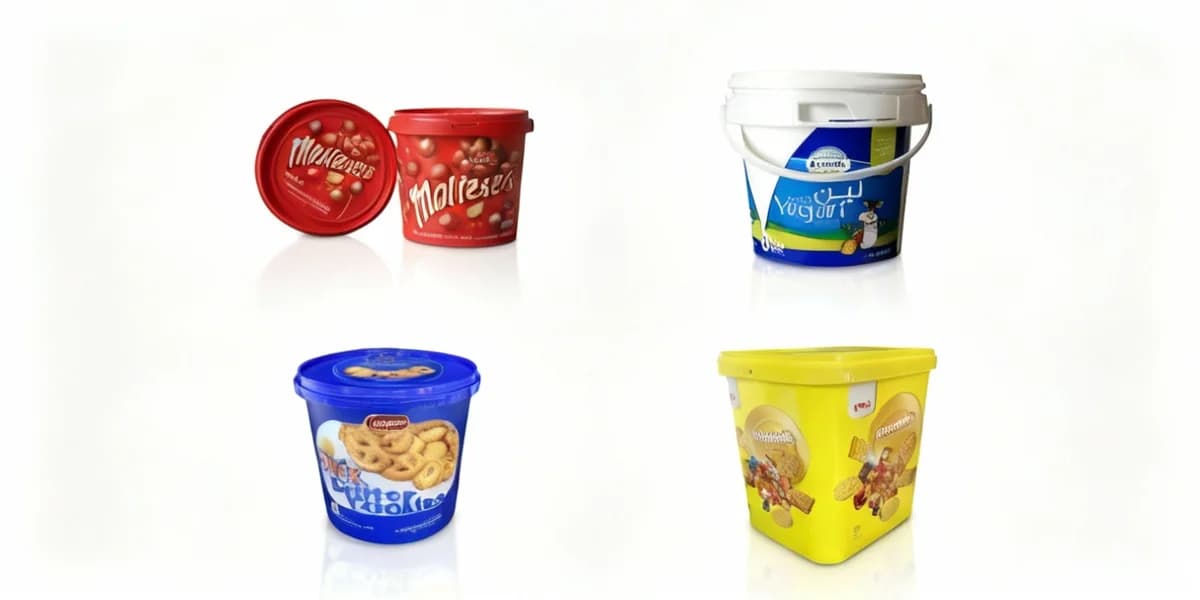
IML decorated pails — premium shelf presentation
Need Expert Advice?
Talk to our engineers about your specific production requirements. Free consultation.
HWAMDA Equipment for the Iraq Market
For Iraqi yogurt pail production, HWAMDA recommends the SPV5-480 (4,800 kN clamping force) with 4-cavity molds for 1 to 2-liter pails and the SPV5-550 (5,500 kN clamping force) with 2-cavity molds for 3 to 5-liter formats. The SPV5-480 produces 2-liter yogurt pails at 30 to 35 grams with 0.6 mm wall thickness, achieving 8 to 10 second cycle times for output of 1,440 to 1,800 pails per hour. The servo-hydraulic drive system delivers energy consumption of 1.0 to 1.2 kWh per kilogram, critical for managing costs given Iraq's variable electricity supply and widespread reliance on generator power in some industrial zones. The machine's robust hydraulic system and INOVA controller are designed to tolerate the voltage fluctuations and power quality issues common in Iraqi industrial areas. SWITEK IML automation provides premium label application for brands targeting modern retail channels. The mold features tamper-evident geometry and is manufactured from DIN 2344 steel hardened to HRC 48 to 52 for long service life exceeding 5 million shots. HWAMDA provides Arabic-language operator interface configuration on the INOVA controller for Iraqi workforce convenience.
Logistics and After-Sales Support
HWAMDA ships to Iraq primarily via ocean freight from Ningbo to Umm Qasr port near Basra, with transit times of 20 to 25 days. For customers in the Kurdistan Region, overland routing via Turkey through the Ibrahim Khalil border crossing is an alternative, with HWAMDA coordinating with experienced China-Iraq freight forwarders. HWAMDA has established partnerships with machinery trading agents in Baghdad and Erbil who provide Arabic and Kurdish language installation supervision, commissioning, and operator training. A consignment of critical spare parts is maintained with both agents for immediate availability. Remote diagnostics via the INOVA controller enable troubleshooting support from HWAMDA engineers, though internet connectivity quality varies by location. HWAMDA provides 12-month warranty from commissioning with an option to extend to 18 months for customers in areas with longer logistics lead times. The company's experience serving over 30 customers in Iraq and the broader Middle East means Iraqi-specific documentation, payment structures, and shipping protocols are fully established.
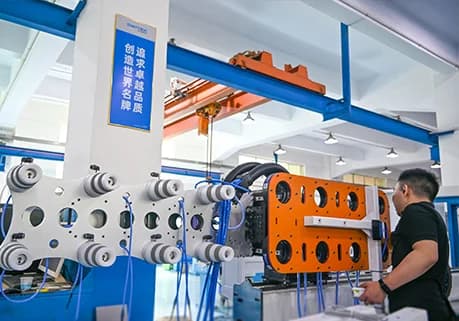
SWITEK IML robot arm with label placement system
Getting Started: Investment and ROI
A complete HWAMDA yogurt pail line for the Iraqi market, including the SPV5-480 machine, 4-cavity IML mold with tamper-evident features, SWITEK IML system, and auxiliaries, represents a total investment of USD 200,000 to 310,000 CIF Umm Qasr. For licensed investment projects, customs duty exemptions under the Iraqi Investment Law can reduce the landed cost by 5 to 8%. Production cost per 2-liter yogurt pail runs approximately USD 0.05 to 0.08, with PP resin at approximately USD 1,200 per metric ton, IML label, energy, labor, and mold amortization. Market selling prices of USD 0.12 to 0.22 per pail in Iraqi retail channels support gross margins of 45 to 60%. At 85% capacity utilization, a single line generates monthly revenue of approximately USD 70,000 to 120,000. Most Iraqi operators achieve full return on investment within 12 to 18 months, among the fastest payback periods in the Middle East due to strong local demand and limited domestic competition. Equipment cost per pail averages USD 0.002 to 0.004 amortized over 5 years. HWAMDA accepts payment by USD letter of credit, T/T with 30% deposit and 70% against bill of lading, and RMB payment options.
Frequently Asked Questions
Yes, HWAMDA's SPV5 series servo-hydraulic machines are designed to tolerate the voltage fluctuations common in Iraqi industrial zones using generator power. The INOVA controller includes built-in voltage stabilization tolerance. HWAMDA recommends a properly sized generator with automatic voltage regulation (AVR) rated at minimum 1.3 times the machine's connected load. For the SPV5-480, this means a generator of approximately 120 to 150 kVA. A voltage stabilizer unit can be supplied as an optional accessory.
Related Guides
Ready to Start Your Project?
Get a free consultation and quotation for your thin-wall packaging production line.
Join 500+ manufacturers in 60+ countries who trust HWAMDA.
Get Free Quote