Morocco Food Packaging Market Overview
Morocco's food packaging market is valued at approximately USD 2.8 billion in 2025, with rigid plastic packaging growing at 5 to 7% CAGR driven by urbanization, modern retail expansion, and the Plan Maroc Vert agricultural development program. The country's GDP of approximately USD 140 billion supports a population of 37 million with increasing disposable income and shifting consumption toward packaged and branded foods. Morocco's dairy sector is anchored by Centrale Danone (a Danone subsidiary holding approximately 55% market share), Copag-Jaouda, and Safilait, with combined processing capacity exceeding 2.5 billion liters annually. The government's Green Morocco Plan has increased domestic milk production by over 60% since 2008, creating sustained demand for dairy packaging capacity. PP resin is imported primarily from Saudi Arabia, Europe, and Turkey at approximately USD 1,250 to 1,400 per metric ton CIF Casablanca. Morocco's free trade agreements with the EU, the U.S., Turkey, and several African countries position the country as an attractive manufacturing base for packaging converters targeting multiple export markets. The Casablanca-Settat and Tangier-Tetouan regions are the primary industrial zones for food packaging production.
Key Specs
- •Morocco's food packaging market is valued at approximately USD 2.8 billion in 2025, with rigid plastic packaging growing at 5 to 7% CAGR driven by urbanization, modern retail expansion, and the Plan Maroc Vert agricultural development program.
- •Morocco's dairy sector is anchored by Centrale Danone (a Danone subsidiary holding approximately 55% market share), Copag-Jaouda, and Safilait, with combined processing capacity exceeding 2.5 billion liters annually.
- •The government's Green Morocco Plan has increased domestic milk production by over 60% since 2008, creating sustained demand for dairy packaging capacity.
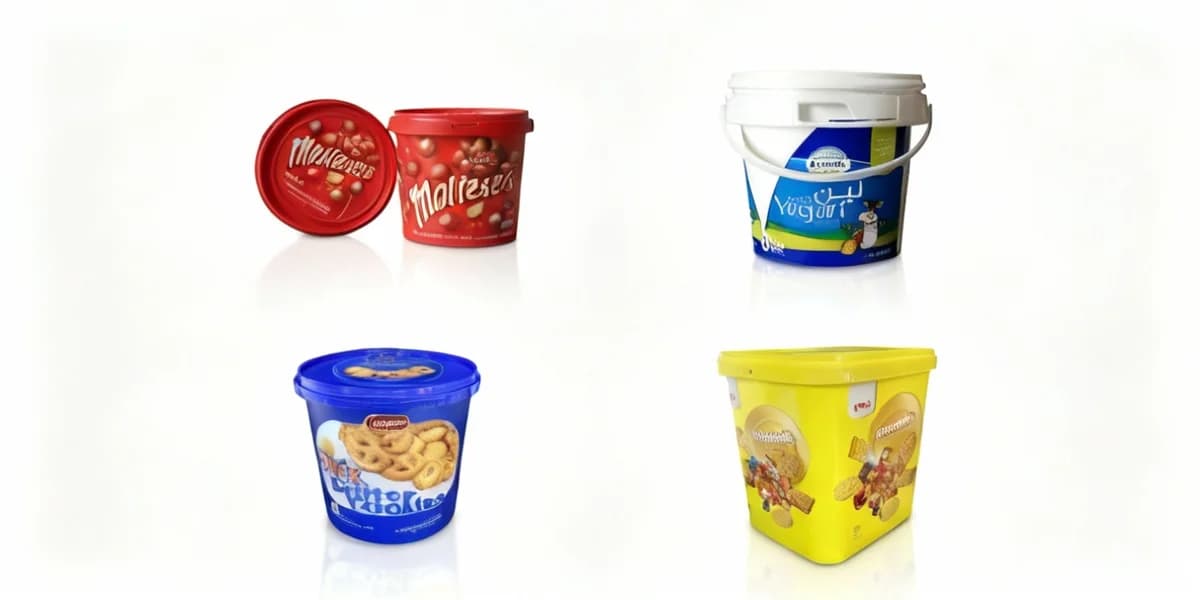
Complete yogurt pail production line with IML
Key Opportunities: Yogurt Pail Sector
Morocco's yogurt pail market is estimated at 300 to 450 million units annually, covering plain yogurt, lben (fermented milk), raib, and flavored yogurts in 1 to 5-liter formats. The 1-liter and 2-liter round pails with tamper-evident lids dominate the market, accounting for approximately 65% of large-format dairy packaging volume. Part weights range from 25 to 45 grams at 0.6 mm wall thickness in food-grade PP. Centrale Danone's investment in premium IML-decorated packaging for its Danao and Activia brands is driving industry-wide adoption of in-mold labeling. Copag-Jaouda and local brands are upgrading their packaging to compete in the expanding modern retail channel, which now accounts for approximately 25% of food distribution through chains including Marjane, Acima, and Carrefour Market. Morocco's position as a dairy product exporter to West Africa, particularly Senegal, Cote d'Ivoire, and Mauritania, creates additional demand for export-quality packaging with extended shelf appeal. The replacement cycle for aging European and Turkish equipment in Moroccan converter plants represents an addressable market of approximately 100 to 150 machines over the next 5 years.
Import Regulations and Certification Requirements
Injection molding machines enter Morocco under HS code 8477.10, subject to import duties of 2.5% on the CIF value, plus 20% VAT. Morocco's customs procedures are relatively efficient, with clearance at Casablanca port typically completed in 5 to 10 working days for industrial equipment. Food-contact packaging materials must comply with Moroccan NM (Norme Marocaine) standards administered by IMANOR (Institut Marocain de Normalisation), which are closely aligned with European EN standards and EU Regulation 10/2011. CE certification on HWAMDA machines is recognized by Moroccan authorities and significantly accelerates the compliance verification process. Morocco's bilateral free trade agreements mean that packaging produced on HWAMDA equipment can be exported to EU markets (under the Morocco-EU Association Agreement), the U.S. (Morocco-U.S. FTA), and numerous African countries duty-free, provided the packaging meets the relevant food-contact standards of each destination. HWAMDA provides technical documentation in French, Morocco's primary business language, including operation manuals, maintenance guides, and CE declarations of conformity.
Key Specs
- •Injection molding machines enter Morocco under HS code 8477.10, subject to import duties of 2.5% on the CIF value, plus 20% VAT.
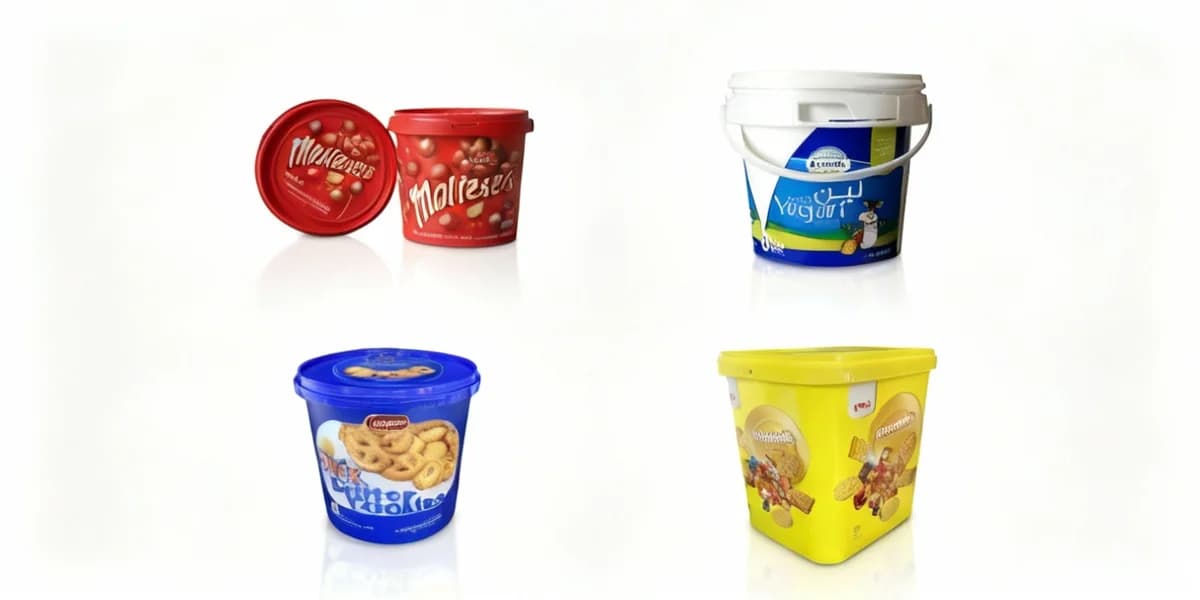
IML decorated pails — premium shelf presentation
Need Expert Advice?
Talk to our engineers about your specific production requirements. Free consultation.
HWAMDA Equipment for the Morocco Market
For Moroccan yogurt pail production, HWAMDA recommends the SPV5-480 (4,800 kN clamping force) with 4-cavity molds for 1 to 2-liter pails and the SPV5-550 (5,500 kN clamping force) with 2-cavity molds for 3 to 5-liter formats. The SPV5-480 produces 2-liter yogurt pails at 30 to 35 grams, achieving 8 to 10 second cycle times for 1,440 to 1,800 pails per hour. The servo-hydraulic drive system consumes 1.0 to 1.2 kWh per kilogram processed, representing significant savings given Morocco's industrial electricity cost of approximately USD 0.10 per kWh. The mold includes tamper-evident lock geometry and IML compatibility with SWITEK automation for premium brand decoration. The INOVA controller supports French-language interface for Moroccan operators. The machine's strengthened platen design ensures uniform clamping force across the pail mold's large projected area, maintaining dimensional consistency critical for lid fit and tamper-evident function. HWAMDA machines handle the full range of thin-wall PP resins available through Moroccan importers, with processing temperatures of 200 to 280 degrees Celsius and MFI requirements of 20 to 40 g/10 min for optimal thin-wall filling.
Logistics and After-Sales Support
HWAMDA ships to Morocco via ocean freight from Ningbo to Casablanca port, with transit times of 22 to 28 days via the Suez Canal. Alternative delivery to Tangier Med port is available for customers in northern Morocco. HWAMDA provides complete French-language documentation packages and has established relationships with experienced machinery agents in Casablanca who provide installation, commissioning, and operator training in French and Arabic. A consignment of critical spare parts is maintained with the local agent. Remote diagnostics via the INOVA controller enable real-time troubleshooting from HWAMDA's engineering center. Morocco's well-developed port infrastructure and customs modernization program ensure efficient equipment clearance, typically within 5 to 10 working days. The proximity of Morocco's industrial zones to Casablanca port means machines can be delivered to most converter facilities within 1 to 2 days of customs release. HWAMDA provides 12-month warranty coverage from commissioning and supports annual preventive maintenance contracts through its Moroccan partner network.
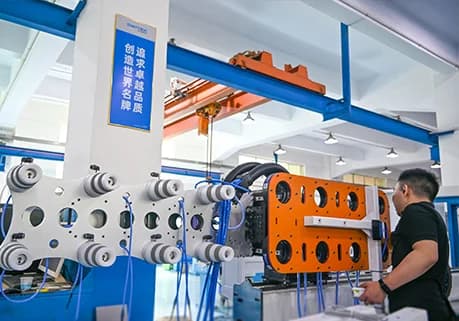
SWITEK IML robot arm with label placement system
Getting Started: Investment and ROI
A complete HWAMDA yogurt pail line for the Moroccan market, including the SPV5-480 machine, 4-cavity IML mold, SWITEK IML system, and auxiliaries, represents a total investment of USD 200,000 to 310,000 CIF Casablanca. Production cost per 2-liter yogurt pail runs approximately USD 0.06 to 0.09, including imported PP at approximately USD 1,300 per metric ton, IML label, energy at USD 0.10 per kWh, labor, and mold amortization. Market selling prices of USD 0.12 to 0.22 per pail support gross margins of 40 to 55%. At 85% capacity utilization running three shifts, a single line generates monthly revenue of approximately USD 65,000 to 110,000. Most Moroccan operators achieve full return on investment within 16 to 22 months. The additional revenue opportunity from exporting packaging to West African markets can accelerate payback. Equipment cost per pail averages USD 0.003 to 0.004 amortized over 5 years. HWAMDA offers payment terms of 30% T/T deposit with 70% against bill of lading, and accepts letters of credit through major Moroccan banks including Attijariwafa, BMCE, and Banque Populaire.
Frequently Asked Questions
Yes, Morocco's extensive free trade agreements enable duty-free export of food packaging to the EU, U.S., Turkey, and numerous African countries. Packaging produced on HWAMDA equipment with EU-compliant PP resin meets the food-contact standards required for these export markets. HWAMDA's CE-certified machines and the mold's compliance with EU Regulation 10/2011 provide the documentation trail needed for cross-border food packaging trade.
Related Guides
Ready to Start Your Project?
Get a free consultation and quotation for your thin-wall packaging production line.
Join 500+ manufacturers in 60+ countries who trust HWAMDA.
Get Free Quote